
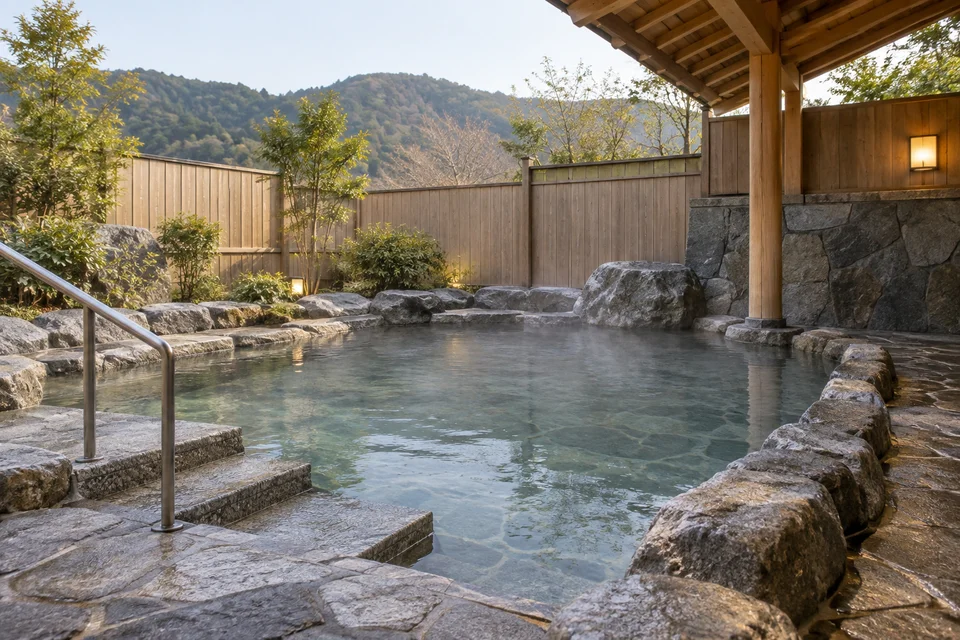
First onsen? Start with these five things
At a typical shared Japanese bath, you change out of your clothes, wash your body at a separate washing station, rinse away the soap, and then soak. The bath is for soaking; the washing happens before you get in. Keep your hair and towel out of the water, and leave your phone with your stored belongings.
You do not have to know every bath word to begin. First make sure this facility and this particular bath work for you: admission, tattoos, companions, access and any health-related precautions need checking before you undress. A private-use or in-room bath can be a useful option if you want privacy, but its conditions still matter.
If something surprises you at the entrance, pause and ask staff. Choosing a different bathing setup, using your room’s shower or skipping a bath is a perfectly reasonable travel decision. Nobody needs to complete every experience on a trip.
Sources: JNTO · How to enjoy onsen · MHLW · Public-bath hygiene management guidance (PDF) · Ministry of the Environment · Bathing and drinking precautions (PDF)
Onsen, sento, rotenburo and private baths
These words answer different questions. Onsen (温泉) describes spring water that meets Japan’s legal definition. Rotenburo (露天風呂) means an outdoor bath. Kashikiri (貸切) describes reserved private use. A bath can be all three, two of them, or just one.
- WATEROnsen 温泉
- Is it natural spring water that meets Japan’s onsen definition?
- PLACERotenburo 露天風呂
- Is the bath outdoors? This says nothing about mixed-gender use.
- USAGEKashikiri 貸切
- Is it reserved for private use? Check who may use it and on what terms.
The labels can overlap: a rotenburo may use onsen water and also be available for private use. Confirm each part separately.
A sento (銭湯) is a public bathhouse; some sento use onsen water and some do not. “Public” or “shared” here means you share the bathing space with other guests, not necessarily that a government operates it. A family bath often means a private-use bath, while an in-room bath is attached to your booked room. Neither label guarantees particular companion permissions or spring water.
For a booking, ask about the water, the setting and the way the bath is used separately. A lovely outdoor tub can still contain ordinary heated water. Japan’s onsen definition concerns the source temperature or specified mineral content; it is not the temperature you should bathe at and is not a safety guarantee.
Sources: Ministry of the Environment · Onsen definition · Tokyo Sento Association · Sento guide (PDF) · Nishimuraya Shogetsutei · Open-air room bath
Shared bath, private bath or in-room bath?
A shared bath can be a straightforward way to experience bathing alongside other guests. A reserved private bath offers time without unrelated bathers, subject to the facility’s rules. An in-room bath may let you use your own bathroom without a reservation for a separate bathing room. The best fit depends on your comfort, your companions, your access needs and the actual room or bath available.
Shared bath
Other guests use the bathing area with you. Usually separate men’s and women’s areas.
Before booking: Check admission and tattoo rules, current entrance signs and operating times.
Private-use bath
A bath reserved for your agreed group or for you alone, often for a booked slot.
Before booking: Confirm companions, tattoo policy, water type, booking, charge and time limit.
In-room bath
A bath attached to the room you book; the room description determines its features.
Before booking: Confirm whether it uses onsen water and which room actually includes it.
“Family bath” may describe a private-use option; it is not permission for every family or companion group.
Private does not mean unrestricted. Do not pay for a slot assuming that tattoos are accepted, that you and your partner may bathe together, or that the water is onsen water. Get answers for the exact bath first. If a room listing says “open-air bath,” check the water description as well as the room name.
For the wider booking, meal and check-in routine, use our first ryokan stay guide. For tatami, futons and room furniture, use the Japanese-style room guide. This page concentrates on the bath itself.
Sources: Solaniwa Onsen · Official FAQ · Saya-no-Yudokoro · Official FAQ · Nishimuraya Shogetsutei · Open-air room bath
Before you go: check these first
Check whether the facility accepts day-use visitors, needs a booking, or is only available to staying guests. Having an onsen in a hotel does not automatically make it open to someone who is not staying there. For a private bath, check the reservation method, permitted group, fee, time slot and what is included.
Look for both last admission and closing time. Last admission can be earlier; cleaning, maintenance or area-switching periods can interrupt access. Do not plan your arrival from a closing time alone. If you have a tight schedule, ask when you need to be out of the bath and changing room.
Before traveling, confirm tattoo rules, towel provision or rental, toiletries, lockers, and any needs involving children, assistance or step-free access. Facility policies can change. A listing, photograph or another traveler’s successful visit does not establish permission for your visit.
At reception, explain whether you want the shared bath or a private-use bath, ask about any uncertainty, and follow the payment and footwear system. Some places have shoe lockers; others ask you to leave footwear elsewhere. Keep any key or ticket as staff instruct you. Do not copy a system from a different property.
Sources: Kishigon Ryokan · Official FAQ · Hakone Yuryo · Official FAQ · Saya-no-Yudokoro · Official FAQ
What should I bring?
Think in terms of one small towel for the bathing area and one larger dry towel for afterward. What a facility provides can depend on your ticket, room or private-bath plan. Towels may be included, rented or sold; shampoo and body soap may be available, but do not assume every bath has them. Ask before buying or packing duplicates.
Bring a hair tie if you need one, your own toiletries if the supplied products do not suit you, and the means of payment the facility accepts. If you need a particular bathing garment, assistance arrangement or storage option, confirm it in advance rather than discovering the issue in the changing room.
Leave larger luggage at an agreed storage location instead of expecting a bathing locker to hold it. Take only what you need for the visit. Ordinary drinking water for before and after the bath is different from drinking hot-spring water; keep drinks in the areas the facility permits.
Sources: Hakone Yuryo · Official FAQ · JNTO · How to enjoy onsen · Ministry of the Environment · Bathing and drinking precautions (PDF)
Men’s bath or women’s bath? Check the sign every time
Read the current sign, even if you used the bath yesterday. Some properties switch which area is assigned to men and women, often so guests can experience different baths. Curtain colors are useful clues in some places, not a rule you should rely on.
- 男湯
- Men’s bathOtokoyu
- 女湯
- Women’s bathOnnayu
- 入替
- Bath areas switchIrekae · check again
These are recognition examples, not a fixed left/right arrangement. Ask staff if the actual sign is unclear.
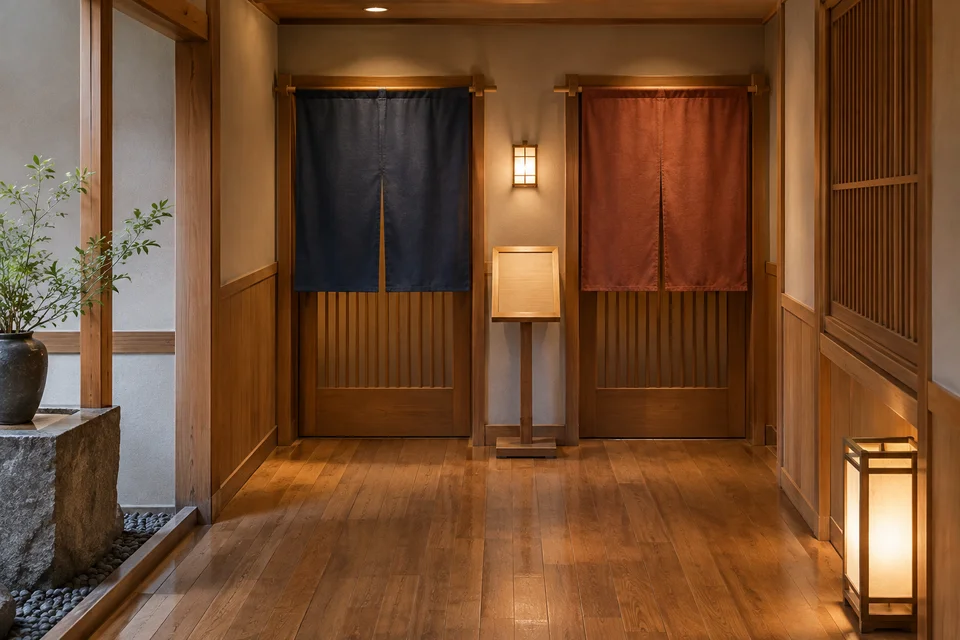
If you cannot tell which entrance is currently yours to use, ask staff before passing the curtain. For questions about gendered admission, privacy or assistance, arrange an appropriate option with the facility in advance; the traveler-specific checks below explain why a private conversation can be more useful than guessing from a sign.
Sources: JNTO US · Japanese bath culture · MHLW · Gendered-bath management notice (PDF)
The changing room: what stays here
The changing room, or datsuijo (脱衣所), is where your clothes and larger dry towel stay while you bathe. Store your phone, wallet and other belongings as the facility directs you. A basket is a place to put things, not a locked safe. If the room uses open baskets, ask about valuables storage rather than leaving valuables unattended.
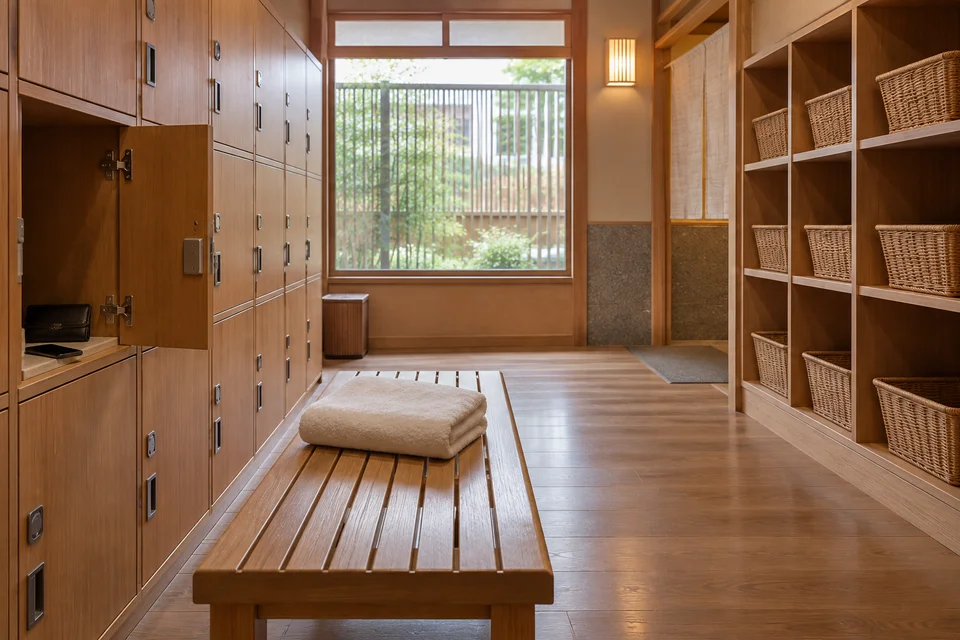
Follow the locker-key instructions. A wrist key may be designed to stay with you, but do not assume every key, ticket or wristband is water-safe. Ask if you are unsure. Keep your small towel and only the washing items you are allowed to take into the bathing area.
Consider removing jewelry when its materials or the facility’s guidance call for it: some spring water can affect metals. For glasses, balance care instructions with being able to move safely. Do not leave yourself unable to see wet floors or steps just to follow a blanket “take everything off” rule. Store items in the agreed place and ask about assistance when needed.
- Clothes
- Phone & valuables
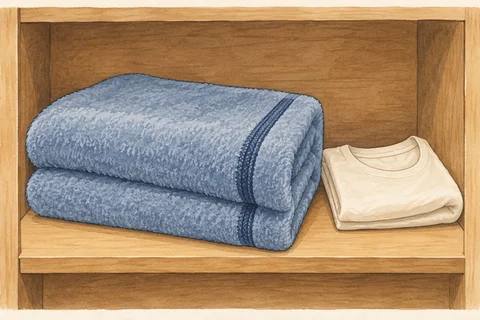 Bath towel
Store these as the facility directs. An open basket is not a locked safe.
Sources: JNTO UK · Tattoos and bathing etiquette · JNTO US · Japanese bath culture · Saya-no-Yudokoro · Official FAQ
Yes, you usually bathe without clothes
In a typical shared onsen bathing area, you bathe without clothes or an ordinary swimsuit. Undress in the changing room. You can use your small towel for modesty while walking, then keep it out of the water when you soak.
There are exceptions with their own rules: designated swimsuit areas, mixed-use leisure facilities, and recognized special bathing garments. They are not interchangeable. Japanese health authorities ask facilities and bathers to accommodate appropriate clean garments used to cover surgical scars; that does not mean an ordinary swimsuit is accepted in every shared bath. Do not question another guest about why they wear one.
If shared bathing does not feel comfortable, investigate a private-use or in-room option. Ask about its conditions first. You can also use your room’s shower or choose not to bathe; the point is to find an arrangement that works for you, not to force yourself through discomfort.
Sources: JNTO · How to enjoy onsen · MHLW · Special bathing garments
Two towels. Different jobs.
The small towel and the big towel have different jobs; bringing the whole towel department into the bath will not make the visit easier. The large dry towel stays in the changing room. The small one can come with you, if permitted, but it stays outside the bath water.
Small towel
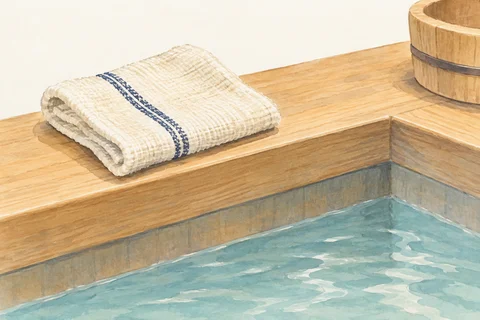
For modesty while walking, washing when appropriate, and drying off before returning to the dry floor.
- Use it in
- The bathing area, if permitted.
- Bath water
- Keep it out.
- Put it
- In your hand, clear of the water, or on a permitted clean, dry surface.
Bath towel
The large dry towel is for drying properly after you return to the changing room.
- Use it in
- The changing room, after bathing.
- Bath water
- Keep it out.
- Put it
- With your clothes in the designated changing-room storage.
Keep both towels out of the bath water. Illustrations show placement, not towel sizes; follow the facility’s storage and towel instructions.
Use the small towel for modesty while walking, for washing where appropriate, and to wipe water from your body before returning to the changing room. For soaking, hold it clear of the water or put it on a permitted dry surface. Do not rinse it in the tub or leave it floating at the edge.
Some facilities have their own towel arrangements. Follow those instructions, and keep rented or supplied items separate from your own so you know what to return.
Sources: JNTO · How to enjoy onsen · Japan Spa Association · Bath etiquette
Wash first: the little stool is where the washing happens
The low stool is not a mysterious tiny chair for watching the bath. It is your washing seat. Sit at a washing station where provided, keep the handheld shower close, and avoid spraying neighboring guests.
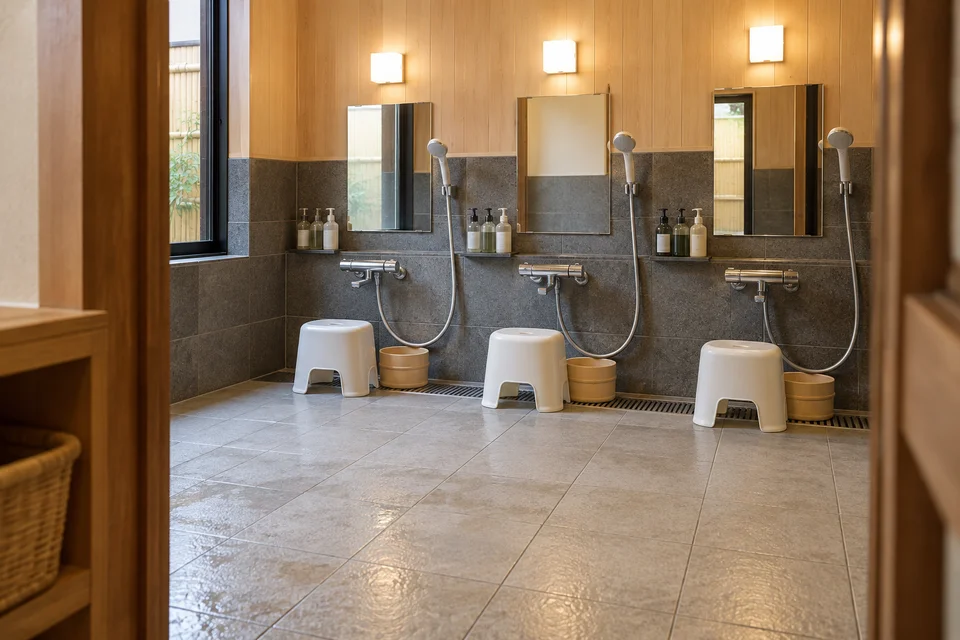
Wash your whole body with soap and rinse thoroughly before entering the soaking bath. Wash away soap and shampoo at the washing area, not in the bath. A quick splash from the rinse bucket, called kakeyu (掛け湯), can help you adjust before entering, but is not a substitute for washing and rinsing your body.
Use the supplied stool and bucket as directed. After washing, rinse and leave them clean for the next person; do not leave your products spread over an unused station to reserve it. If you move between baths, keep any new soap or shampoo away from the soaking water.
If the controls or water temperature are unclear, adjust cautiously and ask for help. You can take your time to understand the shower before you begin.
- 01Wash with soap
- 02Rinse it all off
- 03Then soak
Wash at the shower station. Keep soap out of the soaking bath.
Sources: JNTO · How to enjoy onsen · MHLW · Public-bath hygiene management guidance (PDF) · Koto Sento Association · Bath manners
Hair, makeup and bath water
Tie up long hair so it stays out of the water, including when you lean back. You do not have to wash your hair every time simply because you are using a bath, but hair should not dip into the shared water. If you do shampoo, rinse it away completely at the washing station before soaking.
Remove makeup or other products at the washing area as the facility requires, using products that suit you. Do not turn the tub into the place for washing your face, rinsing hair or cleaning clothes.
Keep them above / outside
- Secure long hair so it stays out.
- Keep your small towel out of the water.
- Wash soap and shampoo away at the washing station.
Putting things into the bath
- Hair dipping into the water.
- A towel floating or rinsed in the tub.
- Soap, shampoo or laundry in the soaking bath.
Sources: JNTO · How to enjoy onsen · Koto Sento Association · Bath manners
Do I have to put the small towel on my head?
No. The towel-on-head look is optional; it is not an entrance exam. You may see people fold the small towel there to keep it out of the water, but you do not need to copy that position.
Keep it in your hand above the water or on a permitted clean, dry surface. Do not put it where it will fall into the bath, block someone’s path or be confused with another guest’s towel. The useful rule is “out of the water,” not “balanced on your head.”
Sources: JNTO · How to enjoy onsen · Japan Spa Association · Bath etiquette
What do I do once I’m in?
Enter slowly, with care on wet steps, and let yourself get used to the heat. Sit or soak quietly in the manner the facility allows. You do not need to stay in because somebody else is staying in. Leave when you need to; a soaking session is not a test of endurance.
Conversation can be quiet rather than forbidden. Keep your voice low enough that other guests can relax. The soaking bath is not for swimming, diving, washing your body or hair, or doing laundry. Move carefully between areas instead of splashing or rushing.
A sauna, cold bath or other special area is optional, not a required stage of onsen bathing. It has separate posted precautions. Do not follow a stranger’s hot/cold routine as if it were personal safety advice; skip an area when you are unsure it is suitable for you.
Sources: JNTO · How to enjoy onsen · Ministry of the Environment · Bathing and drinking precautions (PDF) · MHLW · Public-bath hygiene management guidance (PDF)
Phones and photos: leave them outside
Store your phone before entering shared bathing and changing areas. An empty room is not permission to take photographs. Another guest may enter, and a facility’s camera restriction still applies when nobody else is visible.
If you want a picture of a bath, ask the facility where photography is allowed and whether it provides approved pictures instead. Do not retrieve your phone for a quick “nobody is here” shot.
Private-use and swimsuit areas can also have photography rules. Confirm the policy and the consent of everyone involved; reserving a bath does not automatically grant camera permission. The illustrations on this page show fictional empty spaces, not photographs taken inside a particular facility.
Sources: JNTO · How to enjoy onsen · Hakone Yuryo · Official English guidance · Saya-no-Yudokoro · Official FAQ
Tattoos: there is no single Japan-wide answer
Check the current policy of the exact facility and bathing area. Some welcome tattoos, some allow them with specified covers, and some do not permit entry. Size alone is not permission, and “I can hide it” is not an exception to a policy.
- Explicitly welcomedCheck the stated area and any remaining conditions; one facility’s welcome does not cover another.
- Allowed with a specified coverConfirm the facility’s cover, size, number and coverage conditions. Do not assume your own patch qualifies.
- Not permittedChoose another facility or ask about a genuinely permitted alternative. Hiding it does not override the policy.
- Policy unclear / not publishedContact the facility before traveling or paying. No reply is not permission.
A private bath is only an alternative after the facility confirms that your tattoos are permitted in that specific bath.
A cover rule may specify the facility’s own cover, how many can be used and how completely the tattoo must fit beneath them. Do not assume a waterproof sticker you bought elsewhere meets those conditions. Ask before traveling or paying.
To see why generic advice fails, compare the first-party policies in the sources: Hakone Yuryo announces that it lifted its tattoo restrictions in April 2025, while Nagashima’s Yuami no Shima says tattoos are not permitted even if concealed. These are examples of different facility rules, not recommendations or a promise that another bath follows either one.
Sources: Hakone Yuryo · Official English guidance · Nagashima Yuami no Shima · Official FAQ · Saya-no-Yudokoro · Official FAQ
Private bath does not mean automatic tattoo permission
“Private bath” answers who else shares your booking. It does not automatically mean tattoo OK, couples OK or onsen water. Ask all three questions for the bath you intend to reserve, then check the booking terms.
- 01Are my tattoos permitted here?
- Private use does not automatically settle the tattoo policy.
- 02May these people use it together?
- Couples, families and mixed-gender groups may have different conditions.
- 03Does this bath use onsen water?
- A private or in-room bath may use ordinary heated water.
Also confirm booking method, permitted group size, access, fee and time limit. A room’s appearance cannot answer these questions.
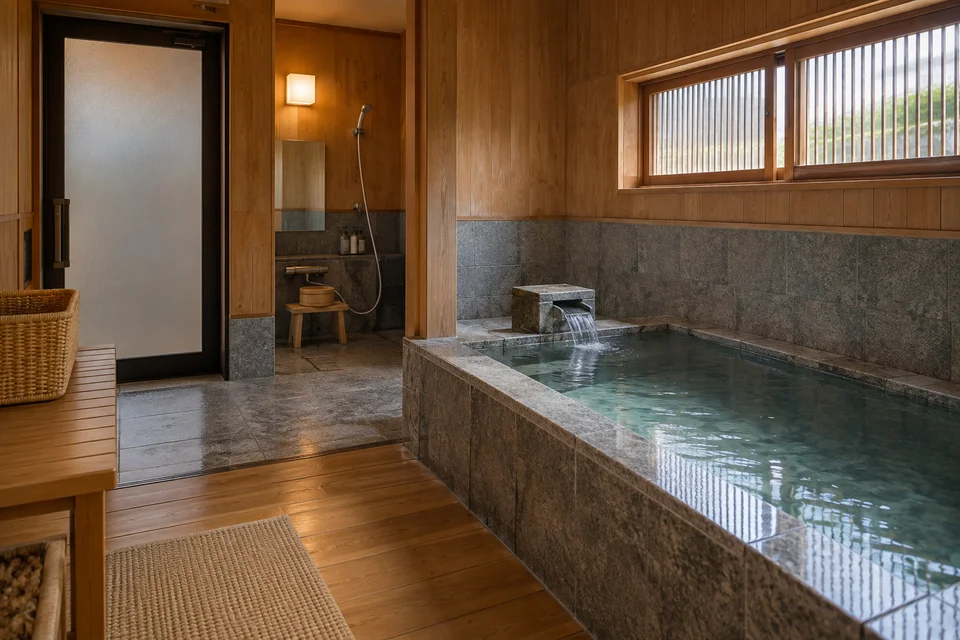
A facility may distinguish its shared bath from a private-use bath in its tattoo policy. That can give you an alternative, but only when the facility confirms it. Do not use “private” to override a restriction or rely on a travel article to supply permission.
Companion rules can be just as specific. Some private-bath operators limit mixed-gender use or define which family groups may use a room together. And an in-room or private outdoor tub can contain ordinary heated water: Nishimuraya’s stated room example demonstrates that the setting and water need separate checks.
Sources: Kishigon Ryokan · Official FAQ · Solaniwa Onsen · Official FAQ · Saya-no-Yudokoro · Official FAQ · Nishimuraya Shogetsutei · Open-air room bath
Couples, families and mixed-gender questions
In the usual gender-separated shared bath, a couple does not bathe together simply because they arrived together. If bathing together matters to you, ask whether an appropriate private-use, in-room or specifically mixed-gender option allows your actual group.
“Family bath” is not a blanket permission label. Describe your companions and, when relevant, children’s ages when you ask. For example, Saya no Yudokoro states restrictions on mixed-gender use of its reserved bath even for spouses or families; Solaniwa sets its own family/group conditions. Do not generalize either facility’s terms to the whole country.
Rotenburo means outdoors, not mixed-gender. Traditional mixed bathing and designated swimsuit facilities have their own clothing and use rules. Confirm those details instead of assuming a swimsuit makes any shared bath a mixed-use area.
Sources: Saya-no-Yudokoro · Official FAQ · Solaniwa Onsen · Official FAQ · MHLW · Public-bath hygiene management guidance (PDF)
Children, privacy and different travelers
Children: ask about this facility and this age
Do not rely on a single nationwide age for a child entering the other gender’s bathing area. Local rules and facility policies differ; some use an age threshold, while current Nagoya guidance uses the timing of elementary-school entry. Confirm with the facility before your visit, and ask how the rule applies to the child you are traveling with.
Check diapers, babies, private-bath eligibility and any child admission rules separately. Keep children supervised around hot water and slippery floors. A private booking does not remove the need for supervision or automatically make its temperature and layout suitable for a young child.
Transgender, nonbinary and privacy-conscious travelers
Do not assume that self-identified gender, a passport marker or a private booking by itself settles admission to a gender-separated shared bath. Japanese national guidance for shared facilities uses physical characteristics in its interpretation; that is background to the facility’s arrangements, not a decision this guide can make about an individual traveler.
A discreet enquiry before booking can establish a comfortable, permitted option: a private bath for you alone, an eligible reserved group arrangement, or a room bath or shower. Confirm any conditions that affect your choice. You do not owe other bathers an explanation of your body, health history or reason for preferring privacy.
Assistance and access
Ask about actual steps, wet-floor transitions, handrails, washing seats, private changing space and permitted companions. A private bath is not necessarily accessible, and an assistant of another gender may need a specifically agreed arrangement. Confirm the route and help available before arriving, rather than expecting staff to improvise transfers or medical care.
Sources: City of Nagoya · Public-bath ordinance changes · MHLW · Public-bath hygiene management guidance (PDF) · MHLW · Gendered-bath management notice (PDF) · Solaniwa Onsen · Official FAQ
Heat, alcohol, menstruation and health
If the water is too hot, stop
Get out carefully if you feel dizzy, faint, nauseated or otherwise unwell. Stand up slowly and ask staff for help. Do not push through symptoms or switch straight into a cold plunge as a remedy. If you want a cooler option, ask whether one is available and appropriate; skipping the bath is fine.
The Ministry of the Environment’s precautions discuss heat, gradual entry and individual condition. There is no single safe soaking time for everyone. Older travelers, people taking medicines and anyone needing assistance should consider their own precautions rather than copying another guest’s routine.
Alcohol and bathing do not mix safely
Avoid bathing while affected by alcohol. Official guidance warns about bathing around drinking; this page cannot give you a universal “wait this many hours” clearance. Plan the bath before alcohol, and do not treat beer as your hydration plan.
Menstruation: facility policy and how you feel are separate checks
Check the facility’s current rule. Some restrict shared bathing or even entry to changing and bathing areas during menstruation. A tampon, menstrual cup, private slot or intention to shower does not automatically override such a rule. If the permitted arrangement is unclear, ask privately or use a confirmed alternative.
Your symptoms and health needs are a separate consideration. This guide does not diagnose you or prescribe menstrual products. You can choose not to bathe without explaining personal details to other guests.
Pregnancy, ongoing conditions and medicines
Pregnancy was removed from Japan’s general onsen contraindications; that is not a statement that every pregnancy, bath or bathing situation is safe. Ask your clinician about your own condition when pregnant, living with an illness or affected by medicines. Check the facility’s posted cautions and the actual water and access arrangements as well.
Do not change prescribed medicines or treatment to fit a bathing plan. An onsen is a leisure choice, not a substitute for care, and the guide does not claim that particular spring water cures conditions.
Drinking water is not the same as drinking spring water
Use ordinary drinking water for hydration, following any personal fluid restriction or medical advice. Do not drink from the bath. Only consider spring water at a designated drinking point explicitly approved for that use, and follow its posted conditions and any medical advice. Bathing water being called “onsen” does not make it drinkable. Official guidance applies additional restrictions to children; do not offer spring water to a child as a souvenir taste.
Sources: Ministry of the Environment · Bathing and drinking precautions (PDF) · Ministry of the Environment · Onsen guidance (English PDF) · Ministry of the Environment · Contraindication review minutes · Consumer Affairs Agency · Bathing-accident precautions · Saya-no-Yudokoro · Usage rules
Before you return to the changing room
For rinsing after the bath, follow the facility’s posted hygiene and spring-specific instructions; ask staff if unclear. Official sources do not support a single “always rinse” or “never rinse” answer for every situation. Skin sensitivity or medical advice may also change the appropriate choice. Do not rinse in the soaking tub.
Use your small towel to wipe water from your body before stepping back onto the changing room’s dry floor. Then use the larger dry towel, dress, collect your belongings and return any rented items or keys according to the facility’s system.
Take a rest and drink ordinary water as appropriate for you. Check you have your phone, glasses, wallet and locker or shoe key before leaving. If you still feel unwell, ask for help instead of hurrying out to keep a sightseeing schedule.
Sources: MHLW · Public-bath hygiene management guidance (PDF) · Ministry of the Environment · Bathing and drinking precautions (PDF) · Japan Spa Association · Bath etiquette
Useful Japanese
You can show a phrase to staff rather than trying to say it perfectly. For a permission question, add the name of the bath and explain who would use it. A “yes” about one bathing area should not be silently extended to another.
- Men’s bath / women’s bath男湯/女湯
- Otokoyu / onnayuRead the actual entrance; the areas may switch.
- Bath areas switch入替
- IrekaeCheck which area is assigned now.
- Private-use bath貸切風呂
- Kashikiri-buroAsk about the terms, not only whether one exists.
- Day-use bathing日帰り入浴
- Higaeri nyūyokuUse this when asking about visiting without staying overnight.
- I have tattoos. May I use the bath?タトゥーがあります。利用できますか?
- Tatū ga arimasu. Riyō dekimasu ka?Ask about the particular bath you plan to use.
- May I enter if I use a tattoo cover?カバーシールを使えば入れますか?
- Kabā shīru o tsukaeba hairemasu ka?Ask which covers and coverage conditions apply.
- Is there a private bath we can use together?一緒に入れる貸切風呂はありますか?
- Issho ni haireru kashikiri-buro wa arimasu ka?Explain who will be bathing together.
- Are towels available to rent or buy?タオルのレンタルや販売はありますか?
- Taoru no rentaru ya hanbai wa arimasu ka?Check small and large towels separately.
- What time is last admission?最終受付は何時ですか?
- Saishū uketsuke wa nanji desu ka?Last entry can be earlier than closing time.
- I feel unwell. Could you help me?気分が悪いです。助けてもらえますか?
- Kibun ga warui desu. Tasukete moraemasu ka?Ask for help promptly; do not keep soaking to finish a visit.
Other words you may see: 掛け湯 (kakeyu) for pouring water over yourself before entering; 脱衣所 (datsuijo) for the changing room; 洗い場 (araiba) for the washing area; and 飲用可 (in’yō-ka) for water designated drinkable, subject to its instructions. None replaces the facility’s full conditions.
First-time Onsen FAQ & official sources
Choosing the bath and getting ready
What is the difference between onsen, sento, rotenburo and a private bath?
Onsen describes qualifying spring water; sento is a public bathhouse; rotenburo means outdoors; kashikiri means reserved private use. These labels can overlap. Check the water, setting and use conditions separately.
Do I have to be naked?
Usually yes in a typical shared bathing area. Designated swimsuit areas and appropriate special bathing garments have different rules. If that arrangement does not work for you, check a permitted private-use or in-room option.
Can I wear a swimsuit or a bathing garment?
Not an ordinary swimsuit in a typical shared bath. Some facilities have separate swimsuit areas; recognized scar-covering bathing garments are a different category. Confirm the rules for your particular area and garment.
Can I cover myself with the small towel?
Yes, for modesty while walking where permitted. Keep it out of the water when soaking; a towel wrapped around you in the bath is not the usual arrangement.
Which towel goes into the bathing area?
The small towel, if permitted. Leave the larger dry bath towel in the changing room. Neither towel should enter the bath water.
Do I have to put the small towel on my head?
No. That is one way to keep it out of the water, not a rule. Hold it clear of the water or use a permitted dry surface.
Washing, hair and privacy
Do I really need to wash before soaking?
Yes: wash your body and rinse soap away at the washing station before using the shared bath. The soaking water is not where you wash yourself.
Is a quick kakeyu splash enough?
No. Pouring water over yourself can help you adjust, but does not replace washing your body with soap and rinsing thoroughly.
Do I need to wash my hair every time?
Not simply because you are taking a bath. Keep hair out of the water; if you use shampoo, rinse it completely at the washing station before soaking.
Can my hair touch the bath water?
Keep it out. Tie up long hair and check that it stays clear when you lean back. The same rule applies whether or not you washed it first.
Should I remove makeup?
Use the washing area to remove products as required by the facility, with products that suit you. Do not wash makeup off in the shared soaking bath.
Can I take my phone into the bath or changing room?
Store it before using shared bathing and changing areas. Follow the facility’s rules for phones and cameras; a waterproof case is not permission.
Can I take a photograph if the bath is empty?
Not unless the facility explicitly allows it. Empty does not mean permitted, and someone else may enter. Private-use areas also need policy and consent checks.
Tattoos, private use and companions
Can I use an onsen if I have tattoos?
It depends on the exact facility and area. Check whether tattoos are welcomed, accepted with conditions or not permitted before traveling or paying.
What if my tattoo is very small?
Size alone does not give permission. Some policies allow specified covers; others refuse entry even if a tattoo is concealed. Ask about your actual tattoo and bath.
Will a cover sticker make my tattoo acceptable?
Only if it meets that facility’s stated conditions. Check permitted covers, coverage, size and number. Do not assume your own waterproof sticker qualifies.
Does a private bath automatically allow tattoos?
No. Confirm that your tattoos are permitted in the specific reserved bath. A private booking by itself does not answer the tattoo question.
Can my partner and I bathe together?
Usually not in a gender-separated shared bath. Ask whether a particular private-use, in-room or mixed-gender option permits your actual companion group.
Can a family use a family bath together?
Often that is the intended option, but the name is not permission for every group. Confirm the companions, children’s ages and facility conditions before booking.
Are onsen mixed-gender?
There are facilities with specifically mixed-gender arrangements, each with its own use and clothing rules. Do not assume an ordinary shared bath is one; confirm the named area.
Does rotenburo mean mixed-gender?
No. It only means the bath is outdoors. Check gendered or private-use arrangements separately, along with its water type.
Until what age can a child use the other gender’s bath?
There is no single answer you should use nationwide. Local rules and facility policies differ, sometimes including school-entry timing. Ask the facility about the child’s age and your planned visit.
What are the options for transgender or nonbinary travelers?
Contact the facility privately before booking to confirm a permitted, comfortable arrangement. Do not assume self-identification or a passport marker settles shared-bath admission. A confirmed private-use or room bath/shower may be an option.
What if I need assistance in the bath?
Confirm the actual access route, steps, seating and permitted assistant arrangement in advance. Private does not automatically mean accessible, and a companion of another gender may need a specifically agreed option.
Comfort, health and practical details
Can I use the bath during my period?
Check the facility’s rule and consider how you feel separately. Some restrict bathing or changing-area access. Products, a shower-only plan or a private slot do not automatically override those restrictions.
Can I bathe while pregnant or with a medical condition?
Ask your clinician about your own circumstances and follow the facility’s posted cautions. Pregnancy is no longer a general contraindication, but that is not individual clearance. Do not change medicines to fit a bath visit.
Can I bathe after drinking alcohol?
Avoid bathing while affected by alcohol. There is no universal waiting time this guide can safely give you. Plan bathing before alcohol and use ordinary water for hydration as appropriate.
What if the bath feels too hot?
Leave carefully; do not try to match other guests’ soaking time. If dizzy, faint, nauseated or unwell, ask for help. Ask about a suitable cooler option or skip bathing; do not use a cold plunge as a remedy.
Can I visit without staying overnight?
Only when the facility offers day-use bathing to you. Check bookings, admission conditions, last entry, closing and cleaning times. A hotel having an onsen is not proof of public day-use access.
Are towels, shampoo and body soap included?
It depends on the facility and your plan. Towels can be included, rented or sold; toiletries vary too. Check the small and large towel arrangements before arriving.
Where do my phone, wallet and luggage go?
Use the facility’s agreed storage. Clothes and the large towel stay in the changing room; an open basket is not secure storage. Ask about valuables and larger bags before leaving them.
Should I rinse after an onsen bath?
Follow the facility’s posted hygiene and spring-specific guidance, and ask staff if unclear. Official guidance differs by context; skin sensitivity or medical advice may change the answer. Do not adopt an absolute always/never rule.
Can I drink the hot-spring water?
Never from the bath. Only consider a designated, approved drinking point and follow its conditions and medical advice. Onsen water is not automatically drinkable, and children need particular caution.
Can I talk, swim, dive or use the sauna?
Quiet conversation can be fine; swimming, diving and washing in the soaking bath are not. A sauna is optional and has separate precautions. Follow the facility’s instructions and skip it if suitability is unclear.
Official sources & what they establish
Sources checked 4 Oct 2026. Japanese primary sources are summarized in our English, not presented as official translations. National guidance explains the background; local requirements and the facility’s current rules decide admission and use.
- JNTO · How to enjoy onsen General visitor orientation. Facility policies and individual health needs still apply.
- Ministry of the Environment · Onsen definition Our English summary of Japanese legal background; source-water criteria are not a safe bathing temperature or a medical guarantee.
- Japan Spa Association · Bath etiquette Association etiquette reference. No fixed safe timing, dose or clinical claim is reproduced.
- JNTO UK · Tattoos and bathing etiquette Used for practical object and storage context only. Its simplified tattoo/private-bath suggestions do not establish admission.
- JNTO US · Japanese bath culture Visitor context, qualified to a typical shared bath. Bath-specific exceptions take precedence.
- Tokyo Sento Association · Sento guide (PDF) Facility type and water type are different questions. No historical prices or amenity guarantees reproduced.
- Koto Sento Association · Bath manners Local association guidance. Its menstruation wording is not treated as a nationwide prohibition.
- MHLW · Public-bath hygiene management guidance (PDF) January 2026 guidance, pp. 20–21 for hygiene. The after-bath instruction is distinguished from the Environment Ministry mineral-water advice; no universal child age is inferred.
- MHLW · Gendered-bath management notice (PDF) June 2023 technical advice, not an individual admission decision or a nationwide ID-check promise. Contact the facility privately about a workable arrangement.
- City of Nagoya · Public-bath ordinance changes Nagoya-specific local change, not a single national age. Rechecked after the effective date.
- Ministry of the Environment · Bathing and drinking precautions (PDF) 2014 technical guidance, pp. 3–6. No universal safe temperature, soak duration, wait-after-drinking interval or drinking dose is given.
- Ministry of the Environment · Onsen guidance (English PDF) 2019 English reference, supplementing the Japanese primary guidance. Not individual medical clearance.
- Ministry of the Environment · Contraindication review minutes Removal is not proof that every pregnancy, water type or bathing situation is safe. Individual clinician advice remains separate.
- Consumer Affairs Agency · Bathing-accident precautions The numerical examples for older adults are not presented as universal safe limits. No instruction to change medication.
- MHLW · Special bathing garments Our English summary of current Japanese guidance. No questioning another guest or blanket approval of every garment.
- Nagashima Yuami no Shima · Official FAQ Named example of a restrictive policy, not a Japan-wide rule.
- Kishigon Ryokan · Official FAQ Property-specific contrast. Tattoo eligibility, staying status and private-bath reservation conditions must all be confirmed.
- Nishimuraya Shogetsutei · Open-air room bath Specific room example proving that private or open-air does not guarantee onsen water; not a claim about every room in Kinosaki.
- Solaniwa Onsen · Official FAQ Named Osaka facility policy. Do not turn its local explanation into a nationwide couples rule.
- Saya-no-Yudokoro · Official FAQ Facility-specific. Its private-bath rule restricts mixed-gender use from age seven even for couples or families; covers are not universal permission.
- Saya-no-Yudokoro · Usage rules Facility policy, not a medical diagnosis or nationwide ban. A tampon, private slot or shower-only intention is not an automatic exception.
- Hakone Yuryo · Official English guidance Current visible policy, contrasted with other facilities. Outdated hidden HTML comments are not used as current instructions.
- Hakone Yuryo · Official FAQ Facility-specific example. No price, opening-hour or current slot guarantee is reproduced.
About rinsing after a bath: MHLW hygiene guidance and the Ministry of the Environment’s mineral-bath guidance do not give the same universal instruction. Follow the facility’s posted hygiene and spring-specific guidance; ask staff if unclear. Skin sensitivity and medical advice may also change what is appropriate.
Facility examples demonstrate differences, not recommendations, rankings or promises of admission. Check directly before booking or visiting. This guide does not provide individual medical clearance or decide which gendered bath a particular traveler may enter.