
The simple version: what is a washitsu?
A washitsu (和室) is a Japanese-style room. In a typical lodging description, that means a room with tatami flooring, often with a low table and bedding that can be put away. Sliding panels, a display alcove and a little sitting space by the window may be part of it, but they are not a package every room must contain.
If you have just walked in, start with this: keep shoes and slippers off the tatami, put your bag on a suitable wooden-floor or luggage area, and check how the bedding will be prepared. Those three actions matter much more than knowing every architectural name.
Where’s the bed? In a traditional washitsu, futon bedding is often stored during the day and laid out on the tatami later. Depending on the property, staff may prepare it or you may do it yourself.
Modern rooms can mix Japanese and Western features, including beds or ordinary chairs. You do not need to recognize every detail to use the room correctly. The guide below is a way to understand what you are looking at, not a list of things you must find.
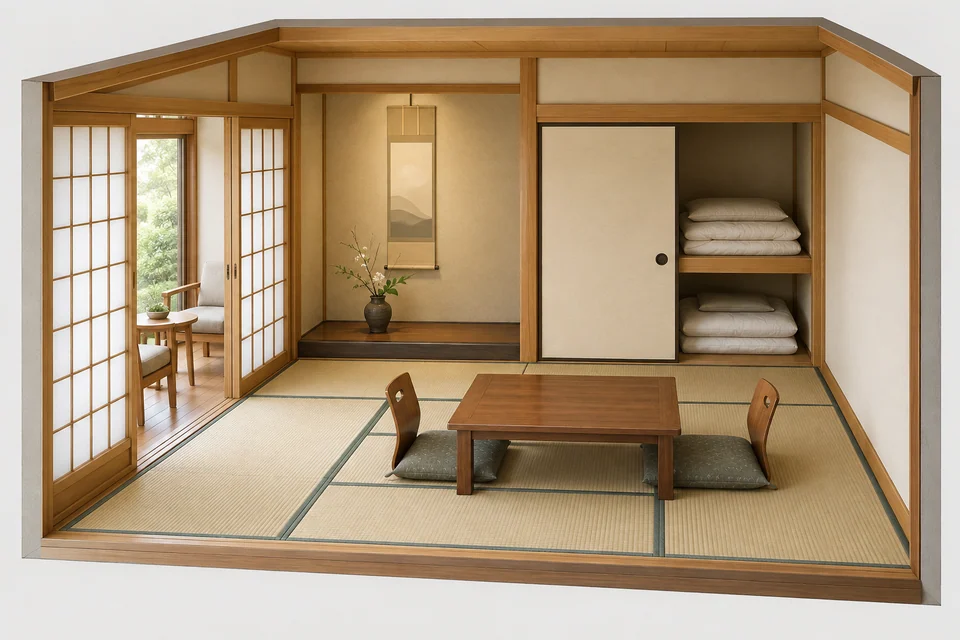
- Shoji
- Paper screens that let light through
- Tokonoma
- Display alcove, not a luggage shelf
- Fusuma
- Opaque sliding panels
- Oshiire
- Closet with folded bedding
- Hiro-en
- Window-side sitting space, if present
- Tatami
- Mat flooring — no shoes or slippers
- Low table
- Zaisu chair + zabuton cushion
Illustration only — Japanese-style room layouts vary. These are features you may see, not a checklist every room must match. This example includes a hiro-en.
Sources: JTA · Enjoying Japanese-style Rooms (PDF, p. 7) · JTA · Ryokan Q&A
First 30 seconds: shoes, slippers and the step up
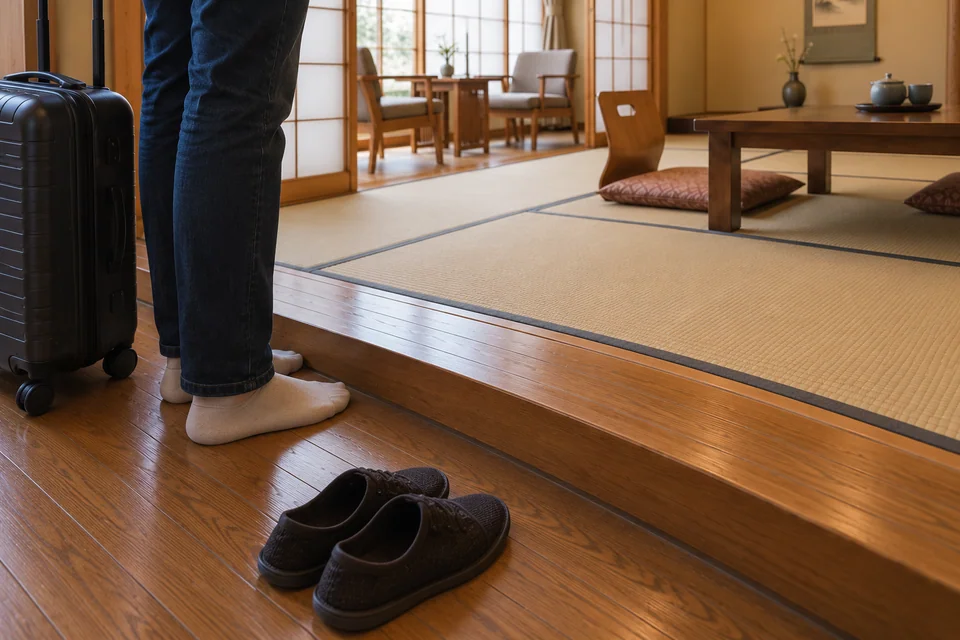
Pause at the entrance before rolling everything inside. There may be a lower shoe area and a raised indoor floor, or you may already have removed your shoes at the inn’s main entrance. Follow the signs and the staff’s instructions for the room you booked; a raised threshold is a useful clue, not the only possible arrangement.
Leave outdoor shoes where the property asks you to. Indoor slippers may be used on wooden or other non-tatami floors, depending on the inn. Take slippers off before stepping onto tatami. Bare feet or clean socks are ordinary options, subject to any instructions from your host.
If you are balancing a suitcase at the threshold, put it down on the suitable non-tatami area first. Check the step, then move yourself and your bag separately. If changing footwear or stepping up is difficult, ask for assistance; room layouts are worth checking before booking as well.
- Outdoor shoesLeave them where the property asks you to.
- Indoor / wooden floorSlippers only where your host’s system allows.
- TatamiNo shoes or slippers.
- Toilet areaDedicated toilet slippers stay here, when provided.
Property slipper systems vary. Follow the room/inn instructions when they differ. Toilet slippers are a separate space rule, not the next stop after tatami.
Sources: JTA · Enjoying Japanese-style Rooms (PDF, p. 7) · MLIT Hokkaido · Enjoying an Onsen Ryokan (PDF)
Tatami: what it is and how to treat it
Tatami is the mat flooring under your feet. A traditional surface is woven from igusa, a rush plant, over a supporting core. The weave and the cloth borders make individual mats easy to recognize. Materials and construction vary, so not every modern tatami mat is built in exactly the traditional way.
Treat the surface as a floor that can be marked, rather than as something too precious to touch. Walk on it without shoes or slippers. Keep dirty suitcase wheels off it and avoid dragging a heavy bag across the weave. Where the room provides a wooden floor or luggage area, that is the better place for large, heavy baggage.
You do not need to spend your stay studying which direction the mat borders run. The practical point is keeping the mats clean and avoiding damage. If you spill something or notice a problem, tell the property rather than trying an unfamiliar cleaning product.
Sources: JTA · Enjoying Japanese-style Rooms (PDF, p. 7) · MAFF · Igusa and tatami surfaces (Japanese)
Why does the room look so empty?
The room is not unfinished. The empty space is part of how it works. In the daytime, the central floor can be a place to sit, drink tea and spread out a little. When it is time to sleep, a low table can be moved aside and futon bedding laid out on the tatami.
That flexibility explains why the bed may not be visible when you arrive. Look for stored bedding or ask about the evening setup; do not assume it was forgotten. A bed-equipped Japanese-style room works differently, and some properties keep futons out rather than putting them away every morning.
Leave enough clear space for the arrangement the property uses. If staff will prepare the bedding, ask whether they need you to move your bags and when they will enter the room.
Sources: JTA · Enjoying Japanese-style Rooms (PDF, p. 7) · JTA · Ryokan Q&A
What do room sizes like “6-jō” and “8-jō” mean?
Jō is a tatami-mat unit used to describe room size. 6-jō (6畳) means roughly a six-mat room; 8-jō (8畳) describes a larger category. It is useful when reading room listings, but it is not a guarantee of one exact floor area.
General explanatory material often approximates one mat at 180 × 90 cm. Actual mat dimensions vary, and some are smaller. The mat-size convention and the way a listing measures its space can affect the comparison.
When two bookings also give square meters, use those figures alongside the photos and floor plan. Check whether a quoted area describes just the tatami room or the wider guest-room space. “8-jō” by itself does not tell you the size of the entrance, bathroom or window-side sitting area.
Sources: MLIT · Guide to Finding a Room (PDF)
Low table, zaisu and zabuton: how do I sit?
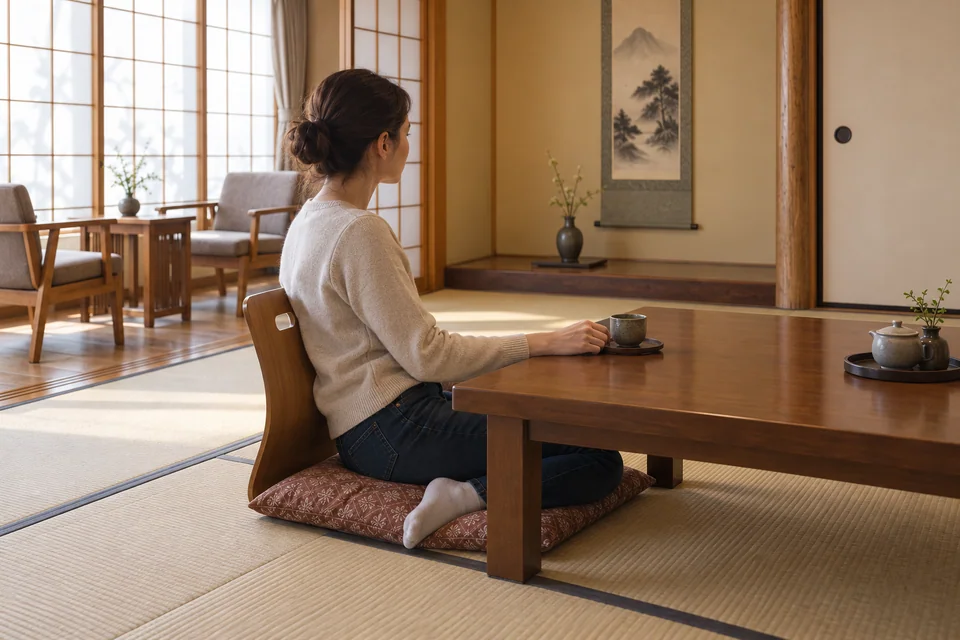
The low table is often called a zataku. A zaisu is a chair with a back but no legs, and a zabuton is a floor cushion. Together they make a sitting area without filling the room with tall furniture.
In an ordinary lodging room, sit in a position that is comfortable for you: cross-legged, with your legs to one side, or another relaxed position that works with the space. You are not taking a posture exam. You do not have to remain in seiza, kneeling with your legs folded under you, just to drink your room’s tea.
A formal tea ceremony or another formal setting can have different expectations; this is about relaxing in your own guest room. If low seating is uncomfortable or difficult to get up from, ask about an ordinary chair. Before booking, check whether your exact room has one rather than relying on a property’s general photos.
Sources: JTA · Enjoying Japanese-style Rooms (PDF, p. 7) · JTA · Ryokan Q&A
Shoji vs. fusuma: look for the light
They can both slide, but they do different jobs. Shoji typically have a wooden lattice with thin, translucent paper: light passes through while the screen softens the view. Fusuma are opaque panels, commonly used to divide rooms or close storage spaces, with a thicker paper or other covering.
A simple memory aid is shoji lets light through; fusuma blocks the view. That describes familiar examples, not every modern panel or material. Your room may have glass behind the shoji, different decorative finishes, or a mixture of older and newer fittings.
Move a panel gently using its frame or intended grip. Do not push on the paper surface. If it sticks or you cannot tell how it opens, ask the staff rather than forcing it.
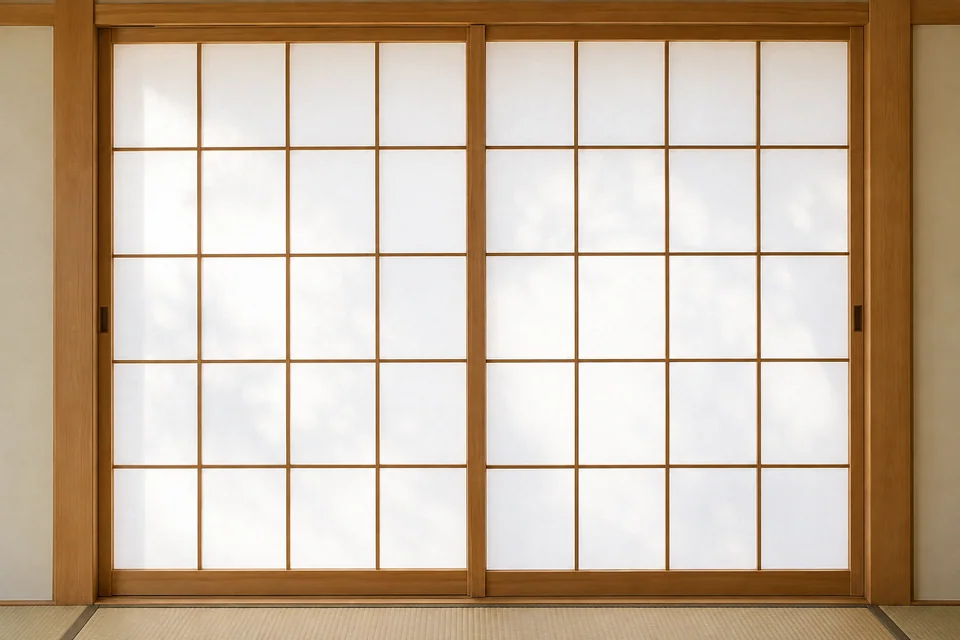
Shoji
Translucent paper screen
Lets light through
Often near windows or outer edges
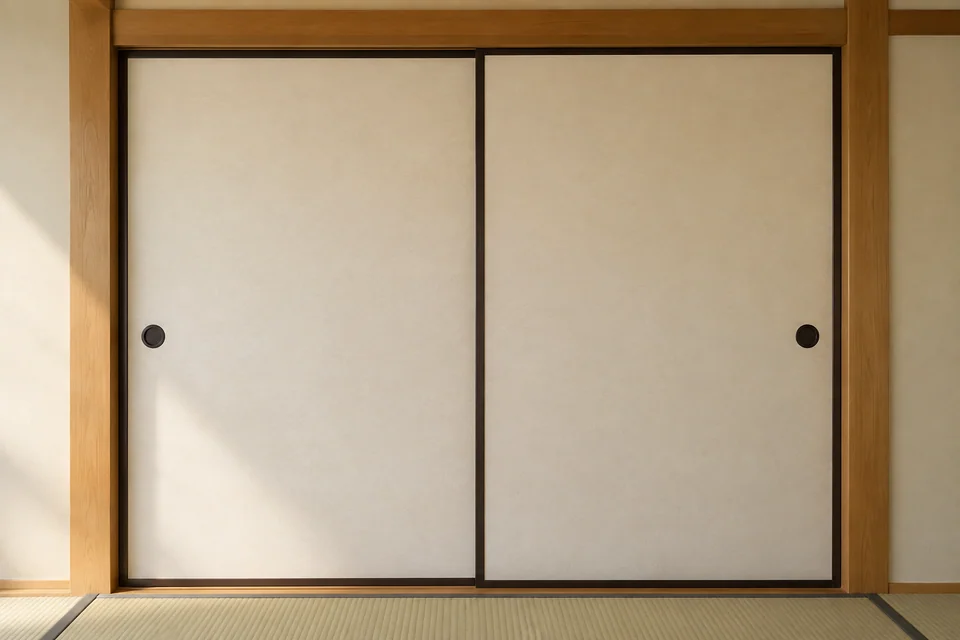
Fusuma
Opaque sliding panel
Blocks the view
Often divides rooms or closes storage
Illustrative images — not actual photographs. Familiar examples, not a universal construction rule; modern designs and materials vary.
Sources: JTA · Enjoying Japanese-style Rooms (PDF, p. 7)
Tokonoma: the alcove that is not a luggage shelf
The tokonoma is a display alcove. You might see a hanging scroll, flowers or a decorative object in a slightly raised recess. It can look temptingly like an empty platform, especially when you are searching for a place to put a suitcase.
Leave the display space alone. Do not sit in the tokonoma or use it for luggage. Put bags in the room’s suitable storage or wooden-floor area instead. There is no action you need to perform at the alcove; noticing the flowers or the scroll is enough.
Not every Japanese-style room has one. If yours does, it is part of the room’s atmosphere, not an extra seat you somehow failed to reserve.
Sources: JTA · Enjoying Japanese-style Rooms (PDF, p. 7)
Ranma: the panel above the sliding doors
Look above the doors or partitions and you may notice a carved, open or otherwise decorative transom called a ranma. Depending on its form, it allows light or air to pass between spaces as well as adding decoration.
Your job here is pleasantly small: nothing. Enjoy the detail if the room has one. It is not a cupboard to open, a control you need to adjust, or a feature every washitsu must include.
Sources: JTA · Enjoying Japanese-style Rooms (PDF, p. 7)
Oshiire: the closet where the bed went
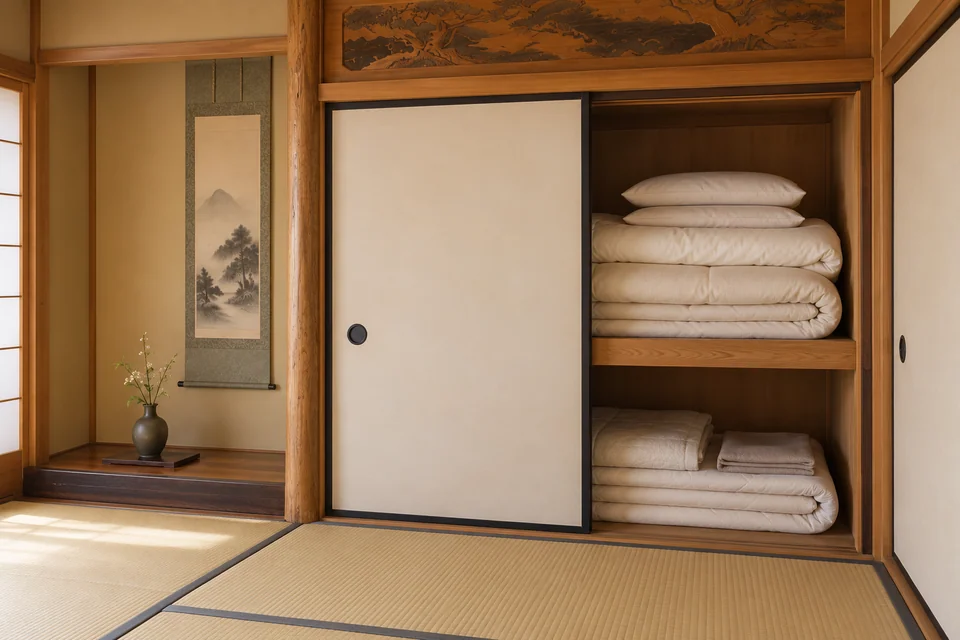
An oshiire is a built-in closet or storage space, often behind fusuma. In a tatami guest room it may hold neatly folded futon bedding during the day. The horizontal shelf inside makes it look quite different from a wardrobe meant only for hanging clothes.
If the closet is intended for your use, slide the panel carefully. Keep bedding clean and do not put dirty luggage on it. If it is marked for staff use, locked, or you are unsure whether you should take bedding out, ask first. Some properties prepare the futons for you; others expect guests to do it.
Open carefully. It is usually futons. Doraemon and ninjas are not standard room amenities.
Sources: JTA · Enjoying Japanese-style Rooms (PDF, p. 7)
The “mystery window space”: hiro-en
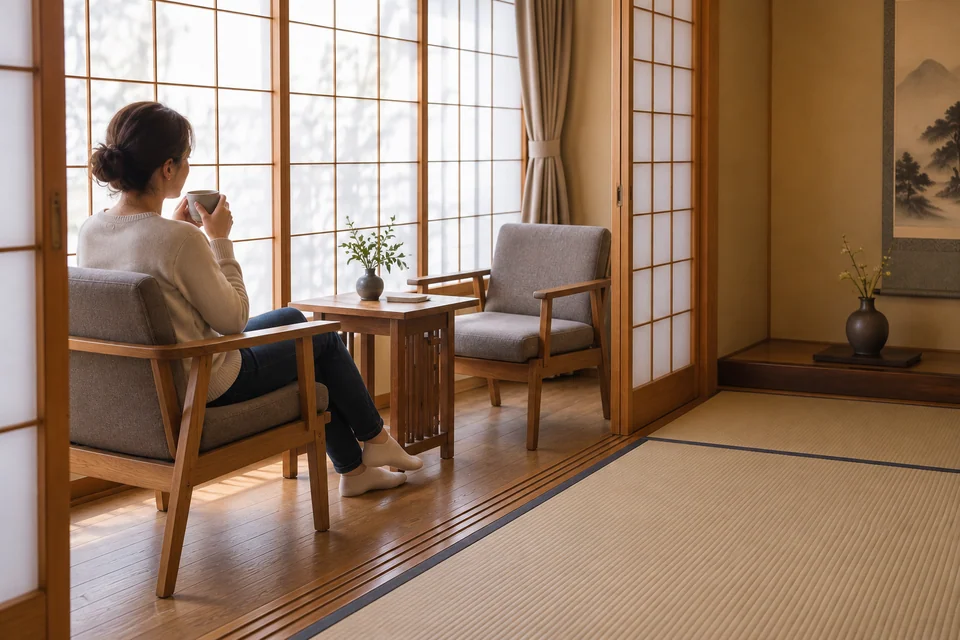
If you have ever wondered why two chairs and a tiny table are squeezed by the window, you are not alone. Some traditional room layouts include a wooden-floored strip on the window or veranda side, often called a hiro-en (広縁). In a lodging room, it may be furnished as a little sitting and viewing space.
When it is set up that way, you can simply use the chairs, have a quiet drink and look out. It gives you another way to enjoy the room, especially if sitting at the low table is not comfortable. It does not need a spectacular garden view to be a useful place to pause.
Not every washitsu has a hiro-en, and not every pair of window-side chairs makes a space formally one. Watch the floor boundary: room and veranda-side levels can differ, and there may be a step. For accessibility, check the actual layout with the property rather than assuming all the floors are level.
Sources: MLIT · Accessible accommodation refurbishment examples (PDF, printed p. 13) · JTA · Ryokan Q&A
Tea and sweets: are they for me?
Tea and small local sweets are a familiar welcome in a Japanese-style guest room. The Japan Tourism Agency’s example room presents them as complimentary local specialties. If your room has a clearly offered welcome set, it is there to be enjoyed.
That example is not a promise for every property or every item on the table. A room can also contain paid minibar stock or snacks with a price label. If the setup is unclear, ask what is included before opening something.
You do not need to perform a tea ceremony. Use the provided instructions for the kettle or tea set, keep hot water on a stable surface, and ask for help if the equipment is unfamiliar.
Sources: JTA · Enjoying Japanese-style Rooms (PDF, p. 7)
Luggage: where should the suitcase go?
Choose the wooden-floor or designated luggage area if the room has one. Keep the bag’s wheels and dirty base away from tatami and bedding, and leave a route to the door. The window-side wood may be useful, but do not block its chairs, door or a narrow passage.
Lift rather than roll or drag a heavy suitcase across a tatami edge. If the room does not have an obvious place for it, ask the property where to put it. Do not improvise a luggage platform in the tokonoma.
For a large bag or several suitcases, plan the space before the evening bedding setup. Your host may have a storage option, but availability is not guaranteed. For choices before you reach the room, see our luggage storage and forwarding guide.
Sources: JTA · Enjoying Japanese-style Rooms (PDF, p. 7)
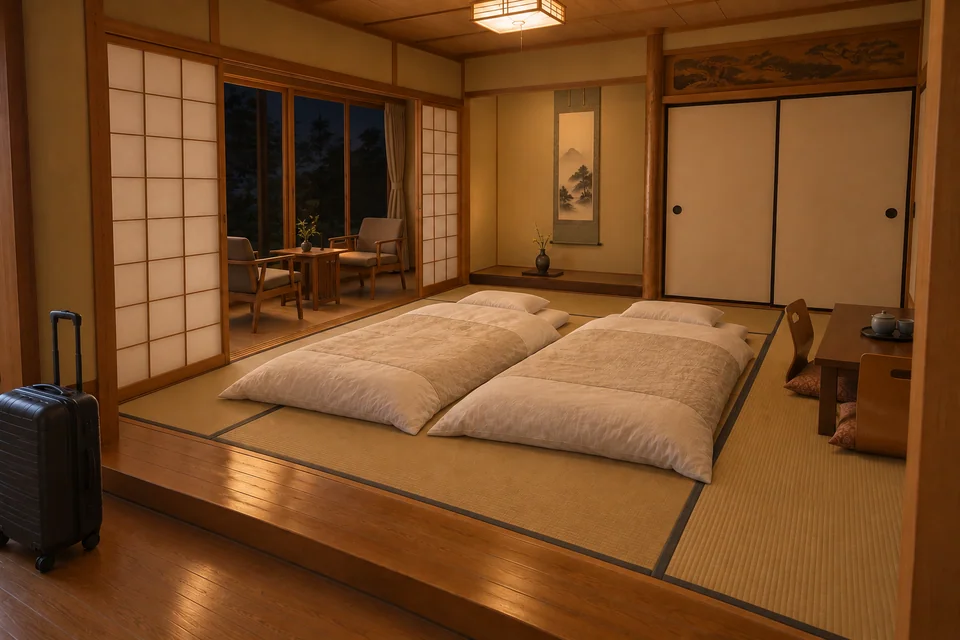
Where do I sleep? How a washitsu becomes a bedroom at night
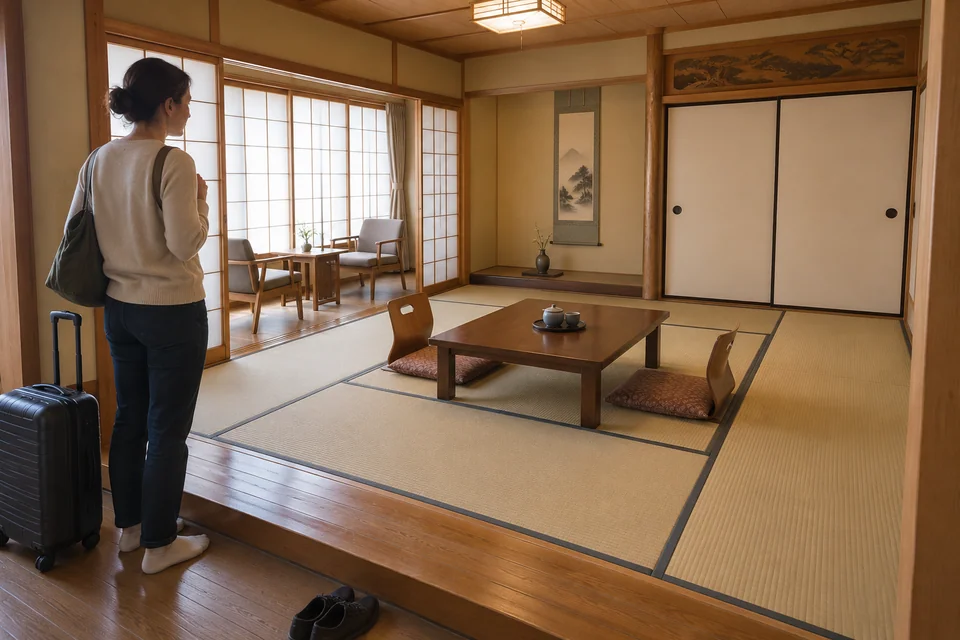
A futon is Japanese-style floor bedding. When it is laid out on tatami, the open sitting space becomes a bedroom. The daytime table moves aside, the bedding comes out, and the room’s apparent lack of a bed suddenly makes sense.
The setup is property-specific. Staff may prepare it at a ryokan, or guests may be expected to put it out themselves. Ask who prepares the bedding, when, and whether staff will enter the room. If you are doing it yourself and cannot identify the layers, ask for a quick demonstration.
If sleeping on the floor or getting up from it does not suit you, choose a room with a bed. Japanese-style rooms with beds and Japanese-Western rooms also exist. Comfort is not an etiquette test, and a tatami photo does not establish what bedding is included in your booking.
The broader evening sequence belongs in our first-time ryokan guide. Here, the main thing is recognizing that one room can serve more than one purpose.
Sources: JTA · Enjoying Japanese-style Rooms (PDF, p. 7) · JTA · Ryokan Q&A
Toilet slippers: the classic small mistake
Some properties provide slippers specifically for the restroom. Change into them when entering that space and change back when you leave. Dedicated toilet slippers stay in the toilet area. They do not go onto tatami or accompany you around the rest of the property.
The classic mistake is walking back out in them. It is common enough to be worth a quick look at your feet before you leave, rather than a long session of worrying about etiquette.
Not every bathroom uses this system. Follow the signs and your host’s instructions, and keep all slippers off the tatami regardless.
Sources: MLIT Hokkaido · Enjoying an Onsen Ryokan (PDF)
That grassy smell: tatami or a problem?
Natural igusa tatami can have a noticeable grassy or earthy fragrance, particularly when it is relatively new. The rush surface and its processing help explain the familiar tatami scent. An older materials reference also notes that new mats can give off a strong igusa smell; people experience smells differently.
That alone is not the same thing as mold, but do not diagnose the room or decide it is safe from smell alone. If you notice visible growth, dampness, a strong persistent musty odor, or anything that concerns your health, tell the property and ask them to check the room.
You do not need to identify the material or the cause before raising a concern. Explain what you have noticed and ask about another room or a suitable alternative if needed. We make no health, allergy or air-quality guarantee for a tatami room.
Sources: MAFF · Igusa and tatami surfaces (Japanese) · IGES · Historical materials presentation (PDF, p. 2)
If your room looks different, that is normal
A modern washitsu may have square borderless mats, a bed, ordinary chairs, different storage or no decorative alcove. A Japanese-Western room might put a bed beside a tatami sitting area. A room can still make sense without matching every picture in this guide.
If comfort or accessibility matters to your choice, ask about the exact room: bed or futon, low or ordinary seating, entrance and window-side steps, and the space you need to move around. The label “Japanese-style” is a starting point, not a detailed accessibility description.
A washitsu is easier once you stop treating every object as a rule you might fail. Most of the room is simply designed to be flexible, quiet and comfortable. Keep the mats clean, use the space thoughtfully, and let your host explain anything unfamiliar. For booking and the rest of the stay, return to the Ryokan Complete Guide.
Sources: JTA · Ryokan Q&A · MLIT · Accessible accommodation refurbishment examples (PDF, printed p. 13)
Useful Japanese for your room
Six names help you recognize the room; the last two questions help you ask what to do. Pointing to the floor, slippers or bedding makes the question clearer.
- Japanese-style room和室
- WashitsuA room type to recognize on your booking.
- Tatami mat / flooring畳
- TatamiPoint to the mats if you are asking about footwear.
- Opaque sliding panelふすま
- FusumaOften used for a partition or closet.
- Translucent paper sliding panel障子
- ShōjiUsually a wooden lattice with light-passing paper.
- Closet / storage space押し入れ
- OshiireMay hold folded futon bedding.
- Window / veranda-side room space広縁
- Hiro-enA feature in some traditional room layouts.
- Do I set out the futon myself?布団は自分で敷きますか?
- Futon wa jibun de shikimasu ka?Ask before unpacking the bedding.
- Do I take off my slippers here?スリッパはここで脱ぎますか?
- Surippa wa koko de nugimasu ka?Point to the boundary you mean.
Common questions
Can I wear slippers on tatami?
No. Take slippers off before stepping onto tatami. Where indoor slippers are used elsewhere depends on the property.
Do I need to wear socks on tatami?
Not as a universal rule. Bare feet or clean socks are ordinary options in a guest room; follow any specific instructions from your host.
Do I have to sit in seiza?
No, not simply to relax in your lodging room. Sit comfortably; a formal ceremony is a different setting. Ask about ordinary seating if floor seating does not work for you.
Can I put my suitcase on tatami?
Prefer a designated luggage or wooden-floor area. Keep dirty wheels off the mats and do not drag a heavy bag across them. Ask where to put it if there is no obvious space.
What is the alcove in the wall?
It may be a tokonoma, a display alcove for a scroll, flowers or another decorative object. Do not use it as a seat or luggage shelf.
What is the difference between shoji and fusuma?
Shoji typically have translucent paper in a wooden lattice and let light through. Fusuma are opaque sliding panels used for partitions or storage. Designs and materials vary.
Where do I sleep in a washitsu?
Usually on futon bedding laid out on the tatami at night. It may be stored away during the day. Ask whether staff prepare it or you do; some Japanese-style rooms have beds or keep futons out.
Can I open the oshiire closet?
If it is intended for guest use, open the sliding panel gently. If it is locked, marked for staff or unclear, ask first. Do not assume you should unpack all the bedding yourself.
What are the two chairs by the window for?
They make a little sitting space when your room is furnished that way — a place for tea and a quiet look outside. In some traditional layouts, this wooden-floored window or veranda-side area is a hiro-en. Not every room has one or uses that name.
Are the tea and sweets free?
Often a welcome set is complimentary, but not every item or property follows that pattern. Check labels or ask if you cannot tell whether something is welcome tea or paid stock.
What do 6-jō and 8-jō mean?
It describes room size in tatami-mat units. Mat dimensions vary, so it is a useful category rather than an exact universal floor area. Compare the supplied square meters too.
Can I move the low table?
It may be moved for futon setup, but do not force heavy furniture or drag it across tatami. Ask which furniture to move and who prepares the room, especially if staff handle the bedding.
What are the special slippers in the toilet?
They are dedicated restroom slippers where that system is used. Change into them inside the toilet area and leave them there when you exit.
Is a grassy tatami smell normal?
Natural igusa mats can have a grassy scent, especially when relatively new. Smell does not establish a room’s condition or safety. Raise visible growth, dampness, persistent mustiness or a health concern with the property.
What if I need a normal bed or chair?
Ask about the exact room before booking. Beds in Japanese-style rooms, mixed Japanese-Western rooms and ordinary chairs are possible, but availability is property-specific.
Is every Japanese-style room the same?
No. Flooring, furniture, storage, slipper systems and room levels can differ. Use this guide to recognize familiar features, then follow the instructions for your actual room.
What this guide is based on
Sources read on 3 Oct 2026. National guidance explains familiar room features; your property’s instructions decide the setup. Japanese-source explanations below are our English summaries.
- Japan Tourism Agency · Enjoying Japanese-style Rooms (PDF, p. 7) Checked 3 Oct 2026 · Example room, not universal amenities or a current guarantee of free items or staff bedding setup. Scanned page visually read.
- Japan Tourism Agency · Ryokan Q&A Checked 3 Oct 2026 · Current first-party visitor guidance; the booked property and room determine available arrangements.
- MLIT · Guide to Finding a Room (PDF) Checked 3 Oct 2026 · General housing terminology, not a hotel measurement standard or an exact conversion for every room.
- MLIT · Accessible accommodation refurbishment examples (PDF, printed p. 13) Checked 3 Oct 2026 · Specific architectural example, not a universal room plan. Two-chair usage is a conditional editorial explanation of furnished lodging layouts.
- MLIT Hokkaido · Enjoying an Onsen Ryokan (PDF) Checked 3 Oct 2026 · Only the room and footwear guidance is used. Property systems vary; bath guidance is outside this page.
- MAFF · Igusa and tatami surfaces (Japanese) Checked 3 Oct 2026 · Our English summary of Japanese primary information. No health or air-quality claims reproduced.
- IGES · Historical materials presentation (PDF, p. 2) Checked 3 Oct 2026 · Historical product-specific descriptive context only. No antimicrobial, allergy, medical or safety guarantee. Browser reader succeeded; direct download returned HTTP 403.
The room pictures and plan illustrate possibilities, not a particular property. Confirm bedding, seating, steps and included items for the room you book. The older IGES reference is used only for scent context, never to judge health or room safety.