
What should I do with my luggage?
For a few hours of sightseeing, start with your own hotel or storage you can return to before collection closes. When changing hotels, forwarding can save carrying if the recipient agrees and you can wait for the confirmed delivery. At an airport, choose the right direction and service. Keeping the bag for a train trip? Check its size and the route before boarding.
What should I do with my luggage?
First: keep essentials with you. Passport, payment, medication, valuables and anything you will need before collection or delivery.
Sightseeing and returning today
OptionAsk your own hotel, or use a suitable locker or storage counter.
Check before choosingCan you return to this location before collection and access close? Check guest eligibility, gate side, bag fit and duration.
If it does not workIf the return trip does not work, change the storage location or carry the bag.
Ask the hotel or check storage →Changing hotels
OptionForwarding can work when you can be without the bag until confirmed delivery.
Check before choosingDoes the receiving hotel agree to the exact arrival date and reservation name? Does the actual dispatch and delivery estimate fit?
If it does not workIf receipt or timing is unclear, do not send it. Carry it, or use storage only if a return trip works.
Build a forwarding plan →At the arrival airport
OptionChoose airport storage for later pickup here, or airport-to-hotel delivery for receipt elsewhere.
Check before choosingFor delivery, confirm the exact product, destination coverage, receiving agreement, acceptance cutoff and arrival time. Same-day is not automatic.
If it does not workNeed the bag sooner, or cannot confirm receipt? Carry it or arrange storage you can return to.
Check arrival-airport options →Heading to the departure airport
OptionSend ahead only when the service confirms enough time for dispatch and airport handover.
Check before choosingConfirm advance shipping deadline, pickup terminal/counter, date, handover hours and flight check-in margin.
If it does not workIf the schedule cannot be confirmed, carry it or choose another confirmed arrangement.
Work backward from your flight →A large suitcase
OptionMeasure first, then compare the actual locker, counter, delivery or train limits.
Check before choosingInclude wheels, handles and protrusions in height, width and depth; also check weight and item count. “Large” is not one shared standard.
If it does not workA box that does not fit is not useful. Ask an eligible staffed counter or check another suitable option.
Measure and check acceptance →Carrying it onto the Shinkansen
OptionMake a separate route-and-size check before boarding.
Check before choosingOn covered routes, an ordinary bag over 160 cm through 250 cm in total normally needs the oversized-area seat arrangement. Other limits still apply.
If it does not workIf you need a reservation and cannot get one, ask the operator about a workable change before boarding.
Check your route and bag →The first storage option is full
OptionCheck another suitable locker area, staffed storage, a bookable shop or your own hotel if eligible.
Check before choosingBefore walking or booking, check acceptance, gate side, bag size, access and pickup deadline.
If it does not workForwarding is an alternative only if recipient consent and delayed receipt fit your trip.
Find a workable backup →Parallel check: whenever you keep the bag for a train trip, check that train’s carry limits too. Storage or forwarding eligibility does not replace the later rail check.
These are choices to verify, not availability or delivery guarantees. A convenient place to leave a bag is only useful if you can get it back when you need it. Keep your passport, payment, medication, valuables and a small supply of essentials with you whichever route you choose.
- Yamato Transport · Hotel-to-hotel forwardingChecked 1 Oct 2026
- Metro Commerce · Locker terms PDFChecked 1 Oct 2026
- JR East · Passenger regulationsChecked 1 Oct 2026
How hands-free travel fits everyday Japan
Parcel delivery, station lockers and staffed storage are practical parts of traveling around Japan. They give you ways to separate a sightseeing day from a suitcase-moving day. Your suitcase does not need to visit every café with you.
The important distinction is simple: storage means collecting again at the agreed place; forwarding means receiving somewhere else later. Neither is automatically available at every station, hotel or destination. Choosing a service by its name alone misses the question that matters: where will you and the bag need to meet next?
For a day trip, storage near your return route may be easier than a counter near your first attraction. For a city-to-city move, forwarding may let you travel with a smaller bag, but only after you have checked receipt and timing. Carrying remains a perfectly workable choice when the bag is manageable and the train permits it.
- JNTO · Luggage storage / hands-free travelChecked 30 Sept 2026
- Yamato Transport · Ordinary TA-Q-BIN acceptanceChecked 1 Oct 2026
- JR East Logistics · Staffed baggage servicesChecked 1 Oct 2026
Before check-in and after checkout
Ask your own hotel first. Tell reception whether you are checking in today, checking out today or hoping to leave a bag for several days. Show your reservation and give the time you expect to return. Agree the collection time before leaving the desk.
Guest eligibility, date, available space, fees and special-item restrictions vary by property. A hotel booking does not guarantee unlimited storage, and a same-day policy does not establish permission to leave luggage between separate stays. For several days away, get a specific agreement instead of assuming the usual checkout-day arrangement applies.
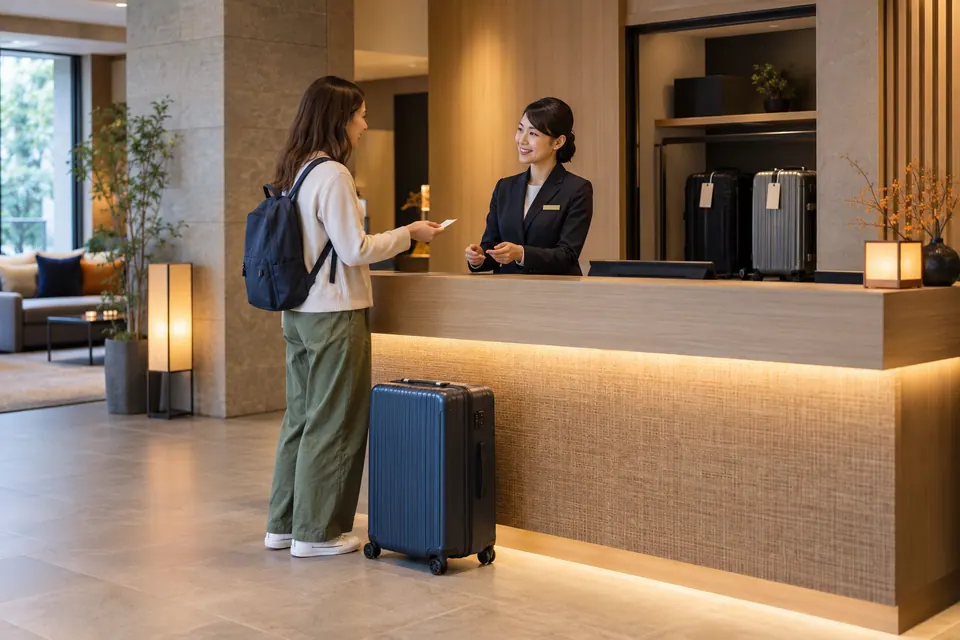
At the named Sotetsu Hotels THE SPLAISIR YOKOHAMA, the published policy distinguishes same-day check-in/check-out storage from receiving a shipment. MIMARU has its own baggage policy and special-item restrictions. These examples show why asking your actual property matters; they are not rules for every Japanese hotel.
Take out anything you will need while the bag is stored. Ask whether you can reopen it during storage, where to collect it and whether late pickup is possible. If the answer does not fit your day, look for a suitable locker or staffed counter before handing over the bag.
- MIMARU · Hotel baggage policyChecked 1 Oct 2026
- Sotetsu Hotels THE SPLAISIR YOKOHAMA · Property baggage policyChecked 1 Oct 2026
- Toyoko Inn Tokyo Nihombashi Bakurocho · Property baggage noticeChecked 1 Oct 2026
Find a locker your bag can actually fit
Start with the station or locker operator’s map. A large station can have several locker banks on different floors, beside different exits, and on opposite sides of the ticket gates. “At the station” is not enough to find the same box after a day out.
Choose a location that works for your eventual collection route. If the lockers are inside the gates, check whether you can legally enter and return with your intended ticket or journey. If they are outside the gates, still check building access and station opening. Do not cross a gate just to reach a box without checking the access arrangement.
- Luggage / bags荷物
- nimotsuGeneral bags or luggage; not a specific service category.
- Coin lockerコインロッカー
- koin rokkāA storage box; payment is not necessarily coins.
- Baggage storage counter手荷物預かり所
- tenimotsu azukarijoA staffed storage place; verify its hours and bag acceptance.
- Inside the ticket gates改札内
- kaisatsunaiWithin the gated station area; check whether you can enter and return.
- Outside the ticket gates改札外
- kaisatsugaiOutside that gated area; still check building access.
Compare the bag’s measured height, width and depth with the box’s internal dimensions and opening. Include wheels and protruding handles or pockets. Labels such as small, medium and large describe this operator’s boxes; they do not establish a national standard. Suitcase liters do not tell you whether the door will close.
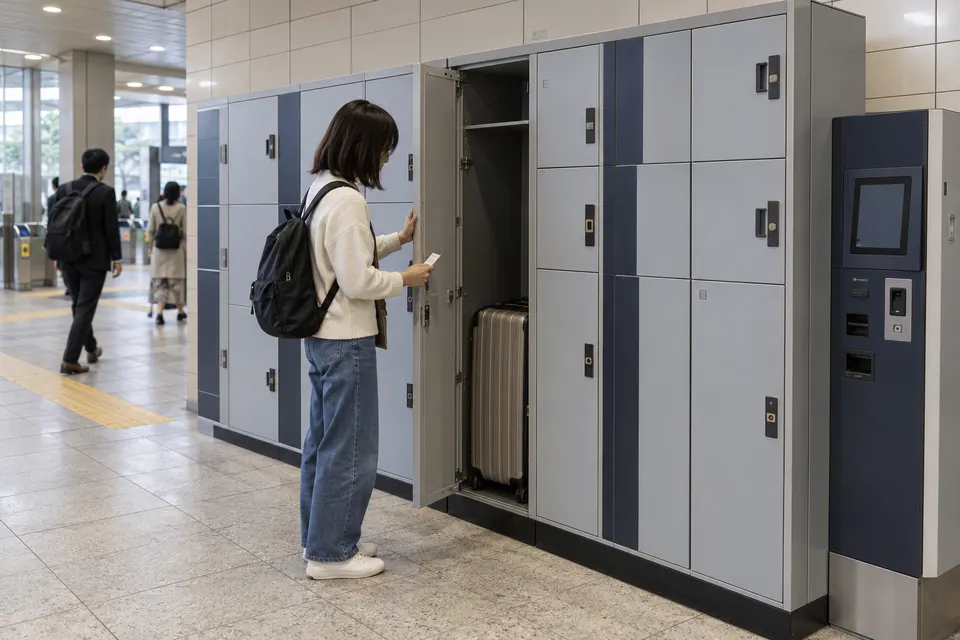
At Tokyo Station, Gransta’s locker information links to maps and availability indicators. Metro Commerce provides its own station-area locker directory. Check the railway area as well as the station name. An online indication of an empty box can change before you arrive; it is not a reservation unless the service actually confirms one.
- Available / empty空き
- akiAn availability indication; it is not an empty-box guarantee.
- In use使用中
- shiyōchūThe box is occupied; other status displays may differ.
- Metro Commerce · Locker locationsChecked 30 Sept 2026
- Nishitetsu Station Service · Locker sizes and rulesChecked 30 Sept 2026
- Gransta Tokyo · Tokyo Station locker mapChecked 30 Sept 2026
- Gransta Tokyo · Availability warningChecked 30 Sept 2026
Use the payment and locking method on this machine
A “coin locker” does not necessarily accept coins. Some installations use a physical key and cash; others use an IC card, receipt or code through a shared terminal. Some newer machines are cashless. Read the accepted payment symbols and instructions on the machine in front of you before loading or paying.
The practical sequence is to find a suitable empty box, read its instructions, fit the entire bag inside, then follow that machine’s payment and locking order. Close the door as directed and confirm that it is secured. Take the required key or retrieval proof. If the door will not shut comfortably, choose another box rather than forcing the suitcase into it.
- Box number and doorCheck internal dimensions, fit the whole bag and record the number.
- Instructions and accepted paymentRead this machine’s order and symbols. A “coin locker” may be cashless.
- Receipt / retrieval proofKeep whatever this machine requires: receipt or code, same IC card/device, or a physical key.
- Operator contactPhotograph the location and contact panel. Use this operator’s help if retrieval fails.
Representative example. Controls vary by locker. This is an original recognition diagram, not a real machine screen or a universal deposit sequence.
An IC card may act as the retrieval key on a compatible installation. Keep the same card or device accessible instead of putting it inside the bag. If the machine issues a receipt, retain it even if you paid by card. Online reservations can have a different payment and retrieval flow from walk-up use; follow the confirmation for your booking.
For example, Multi Ecube’s payment help describes cashless machines and methods that vary by installation. That does not mean every station locker accepts the same cards or mobile wallets. Check your chosen box before making the payment.
- Multi Ecube / JR East Smart Logistics · Payment FAQChecked 1 Oct 2026
- Multi Ecube / JR East Smart Logistics · Retrieval FAQChecked 1 Oct 2026
- JR East · Welcome Suica locker instructionsChecked 30 Sept 2026
Collect your bag before access closes
Before walking away, read three separate conditions: when you can reach the locker, when another charge begins, and how long you may leave the bag. The station or building may close before you return. A charging-day boundary does not extend access, and an extra-day charge does not grant unlimited storage.
Bring the right physical key, same payment IC card/device, receipt or code. Follow this machine’s retrieval instructions and pay any required extra charge. Check the compartment before leaving. Retrieval normally ends that use; do not assume you can open, take something out and close the same locker again under the original payment.
- Retrieve取出 / 取り出す
- toridashi / toridasuMachine wording documented on some panels; 取出 is abbreviated.
- Retrieval ticket取出し券
- toridashi kenKeep the receipt or ticket required by this locker.
- IC cardICカード
- ai shī kādoIf the card is the key, use the same payment card or device.
Maximum duration and charging boundaries are operator-specific. Multi Ecube and Metro Commerce publish different duration rules; they should not be combined into a national “three-day” or “midnight” rule. Overnight storage is an option only if the exact installation allows it and the next pickup time works.
Photograph the station area, locker-bank identifier and box number at deposit. A close-up of a number alone may not be enough in a station with many banks. Keep the retrieval proof privately; a code is useful to someone trying to open the box too.
- Multi Ecube · Locker reservation / duration FAQChecked 1 Oct 2026
- Multi Ecube / JR East Smart Logistics · Retrieval FAQChecked 1 Oct 2026
- Metro Commerce · Locker terms PDFChecked 1 Oct 2026
The lockers are full: your next useful option
Full lockers are a reason to change the plan, not spend the entire morning searching. First check an operator map or available-space indicator for another suitable area. Before walking there, make sure its gate side, bag size and pickup access still fit your day.
If another locker is impractical, look for staffed storage at the station or a nearby bookable shop. A confirmed booking can be more useful than a hopeful walk, but check acceptance and the collection deadline first. Your own hotel may be an option if you are eligible and the return journey works.
- Another suitable locker area: check location, gate side, interior dimensions and access hours.
- A staffed counter: check that it accepts your bag and that its pickup deadline fits.
- A bookable shop: check the selected date, item count, address, booking confirmation and pickup time.
- Your own hotel: ask about guest eligibility, space and collection.
- Forwarding: consider it only if the recipient agrees and delayed receipt fits your trip.
If all options fail, carrying the bag may be the workable next step. Check the train’s carry rules and adjust the day rather than leaving luggage unattended or shipping it to an unconfirmed recipient. The aim is a plan that lasts through collection, not merely an empty place right now.
- Gransta Tokyo · Availability warningChecked 30 Sept 2026
- Gransta Tokyo · Staffed storage countersChecked 1 Oct 2026
- JR East Logistics · Staffed baggage servicesChecked 1 Oct 2026
- ecbo cloak · Duration and extensionChecked 1 Oct 2026
- Yamato Transport · Hotel-to-hotel forwardingChecked 1 Oct 2026
Lost receipt, forgotten location or a closed station
Start with the receipt, booking confirmation or location photo. Note the station, gate side, floor, locker-bank identifier and box number. If you remember only the station, ask staff where the relevant operator’s lockers are; different banks can have different operators and recovery processes.
Contact the operator named on the actual locker. Explain what is missing: a physical key, receipt, payment IC card/device or code. Bring identification and whatever evidence you still have. Operator attendance can take time, and recovery may involve fees or a later office visit. Station staff may help you find the contact but cannot necessarily unlock the box.
For some Multi Ecube payment methods, the same paid IC card or a retained receipt can help when the other is missing. A different IC card is not a substitute, and the alternative depends on how you paid. Follow that operator’s instructions instead of trying unrelated cards repeatedly.
If the station or building has closed, immediate access may be impossible even with the correct key. Contact the operator, explain your next travel deadline and agree the next collection step. If essential documents are inside, say so clearly. For a separately lost passport or an urgent problem, use the Help hub as well; a locker inquiry does not replace that support.
- Multi Ecube / JR East Smart Logistics · Lost payment IC / receipt recoveryChecked 1 Oct 2026
- Multi Ecube / JR East Smart Logistics · Lost receipt recoveryChecked 1 Oct 2026
- Metro Commerce · Locker terms PDFChecked 1 Oct 2026
Changing hotels: build a workable forwarding plan
Forwarding can spare you a suitcase on a city-to-city journey, but plan around the actual delivery estimate. The sending hotel’s ability to arrange a shipment, the carrier’s collection schedule and the next hotel’s receiving policy are separate checks. A bag left after the day’s collection may not begin its trip when you expect.
Start with the next time you need the bag. If you need it before confirmed delivery, carrying is safer for that schedule. If you can travel with a small overnight bag until receipt, work backward from the accepted arrival date. A hotel tomorrow and a hotel several days later create different arrangements; do not use one generic “send it a day ahead” rule for both.
- Ask the current hotel or sending counter whether it can arrange the exact service for your bag.
- Ask the receiving hotel whether it will accept the shipment for your booking.
- Match the reservation name and the exact address and contact details.
- Agree the accepted arrival date with that hotel, including any early-storage limits.
- Confirm actual dispatch and delivery estimate with the sending point or carrier.
- Keep essentials with you for the full confirmed gap, with a workable backup if delayed.
A usual delivery estimate is not a promise for every origin, destination, island, weather condition or missed dispatch. Ask staff to check the route and chosen date. If the timetable or receiver is unclear, keep the bag until the arrangement is confirmed.
- Yamato Transport · Hotel-to-hotel forwardingChecked 1 Oct 2026
- Yamato Transport · Hotel receiving and lead timeChecked 1 Oct 2026
- Yamato Transport · Japanese accommodation delivery FAQChecked 30 Sept 2026
- Yamato Transport · Ordinary TA-Q-BIN acceptanceChecked 1 Oct 2026
Will the next hotel receive the bag?
A carrier being able to deliver does not mean the hotel agrees to receive. Contact the recipient directly before shipping. Give your reservation name, stay dates, number of bags, service and proposed arrival date. Ask whether reception will be staffed and whether any fees or item restrictions apply.
The published policies genuinely differ. Yamato’s accommodation guidance discusses arranging receipt ahead of the stay. MIMARU recommends arrival after the check-in date and says fees may apply before that date. Sotetsu Hotels THE SPLAISIR YOKOHAMA specifies incoming luggage on the check-in day, with the reservation name/date and prepaid shipping. These statements cannot be turned into one national arrival rule.
| Ask the receiving hotel | Why it matters |
|---|---|
| Will you receive this bag for this reservation? | Staffed receipt and guest eligibility must be established. |
| Which arrival date do you accept? | Early arrival, storage duration and fees differ. |
| How should the guest name and stay date appear? | The desk needs to match the shipment to the reservation. |
| Must shipping be prepaid? Any quantity or item limits? | A hotel may refuse recipient-paid freight or unsuitable items. |
Unmanned apartments and private rentals need special care. Rakuten STAY’s unmanned-accommodation FAQ says it cannot receive advance parcels on a guest’s behalf; that help-center scope excludes staffed Rakuten STAY URBAN. Do not extend the statement to every rental or brand property. If nobody has agreed to receive your bag, do not send it there. Use another expressly permitted arrangement or carry it.
- Yamato Transport · Hotel-to-hotel forwardingChecked 1 Oct 2026
- Yamato Transport · Hotel receiving and lead timeChecked 1 Oct 2026
- MIMARU · Hotel baggage policyChecked 1 Oct 2026
- Sotetsu Hotels THE SPLAISIR YOKOHAMA · Property baggage policyChecked 1 Oct 2026
- Rakuten STAY · Unmanned accommodation receiptChecked 1 Oct 2026
- Rakuten STAY · Help-center brand scopeChecked 30 Sept 2026
At the delivery counter: form, payment and tracking
Make sure the desk sends luggage rather than merely storing it. Tell staff the destination and when you need receipt. Show the agreed hotel details and confirmation so you can check the address together before handover. Do not rely on an English hotel name alone when several properties share similar names.
- Yamato Transportヤマト運輸
- Yamato Un’yuThe operator’s company name.
- TA-Q-BIN宅急便
- takkyūbinYamato’s named service, not a generic name for all luggage forwarding.
- Waybill送り状
- okurijōThe shipping form / label.
- Tracking number伝票番号 / 追跡番号
- denpyō bangō / tsuiseki bangōThe number you need to follow the shipment; wording varies.
The waybill or shipping label needs accurate recipient and sender information. Check the reservation name, exact hotel address, destination phone number, stay dates, agreed delivery date, contents and your own contact details. A requested delivery date is subject to the service’s conditions; writing it on the form does not override transit or the hotel’s policy.
Confirm the price and accepted payment before sending. Use the payment arrangement agreed with the receiving hotel. Sender-paid guest luggage is the practical default to confirm; do not choose recipient-paid freight simply because it appears on a form. Yamato’s accommodation guidance distinguishes guest luggage from particular arrangements with an employee receiver, so this is not a ban on every freight-collect shipment.
- Sender pays shipping発払い / 元払い
- hatsubarai / motobaraiSender-paid freight terms. Not every service displays both.
- Recipient pays shipping着払い
- chakubaraiReceiver pays freight; this is not payment for purchased goods.
Keep the waybill copy and tracking number where you can reach them. Check the bag count and destination once more with staff. TA-Q-BIN is Yamato’s named service; “luggage forwarding” is the general category. Products, size/weight limits, dispatch cutoffs and payment options differ by operator and sending point, including convenience stores.
- Yamato Transport · Counter arrangementChecked 30 Sept 2026
- Yamato Transport · Ordinary TA-Q-BIN acceptanceChecked 1 Oct 2026
- Yamato Transport · Waybill terminologyChecked 30 Sept 2026
- Yamato Transport · Hotel receiving and lead timeChecked 1 Oct 2026
What stays with you — and what if delivery is delayed?
Keep your passport and other travel documents, money and cards, medication, valuables, phone and charger, and enough clothing and personal supplies for the confirmed delivery gap. Review the service’s prohibited contents too. “I packed it in the suitcase” is not a useful answer when you need it before the suitcase arrives.
Storage can also limit access to contents. A shop may move bags away from its front desk, and a locker retrieval may end the paid use. Put day-use items into the bag you carry before depositing or handing over the suitcase. Ask the service about access if you expect to need something later.
If delivery is late, use the retained tracking number to check the shipment, then contact the carrier and receiving hotel. Tell them your stay and next departure dates. Confirm whether the hotel has received it rather than assuming a tracking status means it is ready at reception.
A changed destination or additional forwarding may require another arrangement and freight charge. Ask the carrier before redirecting it. Do not assume guaranteed same-day recovery, compensation or free onward delivery. Keep a small practical backup with you so a delay is inconvenient rather than the end of your travel day.
- Yamato Transport · Waybill terminologyChecked 30 Sept 2026
- ecbo cloak · Excluded contentsChecked 30 Sept 2026
- ecbo cloak · Access during storageChecked 30 Sept 2026
- JAL ABC · Standard airport-to-destination English guideChecked 30 Sept 2026
Arriving at Narita, Haneda or Kansai
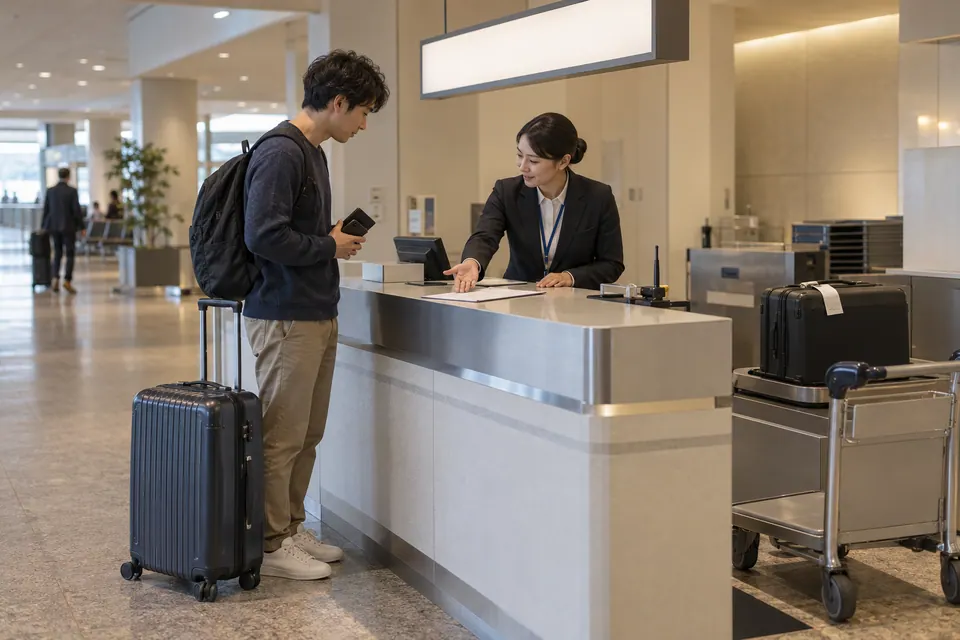
At the arrival airport, decide whether you want to collect the bag here later or receive it at the hotel. Those are different services. For delivery, give the exact hotel address and ask whether the product covers it, accepts the bag and can meet the agreed receiving date and time.
Some specific airport-to-hotel products offer same-day service under conditions. Others deliver the following day or later. Even a qualifying same-day service may arrive in the evening; confirm that hotel reception agrees and keep what you need for the afternoon with you. Counter closing time is not the same as the shipment acceptance cutoff.
| Arrival airport | What to verify at the exact counter |
|---|---|
| Narita | Terminal, provider, destination area and exact product. JAL’s separate same-day offer and JAL ABC’s standard airport delivery are different; a suspension statement for the standard product does not describe every Narita service. |
| Haneda | Terminal and service, eligible receiving area, current drop-off deadline, bag limits and hotel receipt time. Airport storage is a separate arrangement. |
| Kansai | Exact JAL / JAL ABC service, destination coverage and current acceptance deadline. Do not infer a cutoff from general counter hours or another product’s page. |
Use the linked official airport/operator directory to identify your counter. No national timetable or price comparison can replace checking the product, terminal and day. For the arrival process before this step, use After Landing in Japan.
- Yamato Transport · Haneda/Narita airport deliveryChecked 1 Oct 2026
- JAL · Same-day luggage delivery productChecked 1 Oct 2026
- JAL ABC · Standard airport deliveryChecked 1 Oct 2026
- JAL ABC · Separate Kansai hotel deliveryChecked 1 Oct 2026
- Narita Airport · Official delivery directoryChecked 1 Oct 2026
- JAL ABC · Kansai Airport countersChecked 1 Oct 2026
Send a bag ahead to your departure airport
Work backward from your flight, including airline check-in and the actual baggage handover hours at the destination counter. An airport terminal being open does not mean the delivery counter can hand over your bag then. Early flights need particular care.
Ask the chosen service for its advance shipment deadline from your origin. Confirm the airport, terminal, pickup counter, collection date, recipient name, flight information and proof you must bring. The deadline for sending ahead is different from an arrival-airport same-day service. A hotel receiving a bag today does not establish a reverse service to the airport today.
Before dispatch, check that the bag will be ready for collection early enough for your flight and that you can reach the correct counter. Narita’s official directory specifically warns about collection for early flights. Do not plan to collect at an arrivals desk when the service specifies a departures desk or a different terminal.
If the service cannot confirm the schedule, do not ship optimistically. Carry the bag or use another confirmed arrangement. Keep travel documents and flight essentials with you, along with the waybill and the exact pickup instructions.
- JAL ABC · Standard airport deliveryChecked 1 Oct 2026
- Narita Airport · Official delivery directoryChecked 1 Oct 2026
- JAL ABC · Airport counter directoryChecked 30 Sept 2026
Airport storage for a long wait or late flight
Temporary airport storage can help during a long wait if you can return to the agreed counter. It does not forward the bag to your hotel or automatically make it available at another terminal. Check where you deposit and where you collect before leaving.
Ask about opening and collection hours, overnight or multi-day eligibility, fee calculation, bag acceptance and retrieval proof. The airport directory and provider page may describe duration or billing differently; the selected counter must confirm the conditions that apply to your storage. This guide intentionally gives no airport-wide maximum-day rule.
- Reception / service hours受付時間
- uketsuke jikanService-acceptance hours; not automatically dispatch or collection cutoff.
- Opening hours営業時間
- eigyō jikanOpening hours; pickup can have a separate deadline.
- Baggage手荷物
- tenimotsuContext-dependent baggage wording; it does not always mean airline carry-on.
For a late flight, choose a collection time that leaves room for the counter’s deadline, the walk to your terminal area and airline check-in. For an overnight stay or early departure, verify the next morning’s handover as well. Keeping the receipt is necessary, but it cannot open a closed counter.
Haneda’s official storage directory, Narita’s storage directory and JAL ABC’s Kansai counter page help locate the relevant service. Check the current counter details rather than treating the terminal’s general opening as its storage schedule.
- JAL ABC · Airport baggage storageChecked 1 Oct 2026
- Haneda Airport · Official storage directoryChecked 1 Oct 2026
- Narita Airport · Official storage directoryChecked 1 Oct 2026
- JAL ABC · Kansai Airport countersChecked 1 Oct 2026
Staffed station counters and bookable shop storage
A staffed counter can be useful when the box is too small, lockers are full or you prefer to ask someone about the bag. Still check acceptance first. “Staffed” does not mean every bag is accepted, contents stay accessible or overnight storage is available.
Different Tokyo Station counters illustrate the variation: Gransta lists named services with particular same-day pickup limits, while JR East Logistics describes multi-day service at selected counters. Check the named counter, gate side and selected date; do not combine them into a general Tokyo Station rule.
Bookable shop storage, such as ecbo cloak, is another option. It is an example, not a ranking or endorsement. Read the actual shop listing for location, opening, available dates, size/weight and handling restrictions, number of items, booking/payment and the reserved pickup time. Do not walk to a listing expecting a space that has not been confirmed.
At check-in, show the requested booking evidence and confirm item count. At collection, follow the shop’s process and keep within the agreed time. Ask beforehand about access to contents, overnight keeping or several days. If you need an extension or will miss pickup, contact the service promptly instead of assuming another self-booking extends the original storage.
The price can depend on shop, item count and dates. Check the displayed total before booking and any extra-charge conditions for late collection. A national price table would make unlike services look interchangeable; your actual booking total is the useful number.
- Gransta Tokyo · Staffed storage countersChecked 1 Oct 2026
- JR East Logistics · Staffed baggage servicesChecked 1 Oct 2026
- ecbo cloak · Check-in processChecked 1 Oct 2026
- ecbo cloak · Check-out processChecked 1 Oct 2026
- ecbo cloak · Large luggage acceptanceChecked 30 Sept 2026
- ecbo cloak · Duration and extensionChecked 1 Oct 2026
- ecbo cloak · Charge explanationChecked 30 Sept 2026
- ecbo cloak · Missed collectionChecked 30 Sept 2026
A large suitcase: compare acceptance, not labels
Measure before choosing. A locker needs the suitcase to fit each internal dimension and opening. A shop may limit weight or require one-person handling. A carrier sets conditions for its particular product. A train has its own carriage limits. Passing one test does not pass the others.
Height + width + depth = total three sides.
Include wheels, fixed handles, pockets and other protrusions. Check the service’s measuring instructions and how it treats an extendable handle.
A locker also needs each individual dimension to fit its usable interior and doorway. A total, an airline size label or suitcase liters cannot establish that.
Check weight, longest side, number of pieces and handling limits separately.
Exactly 160 cmNot the formal oversized category on the covered Shinkansen routes.
Over 160 through 250 cmNormally needs the oversized-area seat arrangement on covered routes.
Exactly 250 cmWithin the normal total-size maximum, subject to weight, longest-side and other rules.
“Large suitcase” is useful everyday English but not a shared service category. Airline baggage labels and suitcase liters do not establish locker fit, forwarding eligibility or a rail reservation requirement. Separate the measurement from the acceptance rule, then check the service you intend to use.
If the bag is unsuitable, ask about a genuinely eligible alternative rather than assuming a staffed desk accepts everything. Special equipment, a stroller or several shopping bags can need a separate check. Splitting essentials into a smaller bag may make a delivery gap manageable, but every item you store or carry still has to meet its own conditions.
- Nishitetsu Station Service · Locker sizes and rulesChecked 30 Sept 2026
- JR Central Retailing Plus · Locker FAQChecked 30 Sept 2026
- ecbo cloak · Large luggage acceptanceChecked 30 Sept 2026
- Yamato Transport · Ordinary TA-Q-BIN acceptanceChecked 1 Oct 2026
- JR East · Passenger regulationsChecked 1 Oct 2026
Taking the Shinkansen with luggage
Check your route and the measured bag before boarding. For ordinary JR baggage, the normal allowance is up to two qualifying items, each within 250 cm in total three sides, 2 m on the longest side and 30 kg. Small ordinary personal items have exemptions, and special items or unsuitable contents have further conditions. These are JR rules, not a rule for every private railway.
On the Tokaido, Sanyo, Kyushu and Nishi Kyushu Shinkansen, ordinary luggage with height + width + depth over 160 cm through 250 cm normally needs a seat with an oversized baggage area. Exactly 160 cm is not in that formal oversized category. Exactly 250 cm is within the normal total-size maximum, provided the other limits and conditions are met. Over 250 cm exceeds that ordinary total-size limit.
| Route / arrangement | What it means for your bag |
|---|---|
| Tokaido / Sanyo / Kyushu / Nishi Kyushu | For a qualifying ordinary bag over 160 cm through 250 cm, arrange the appropriate oversized-area seat before boarding. Check the actual train’s exceptions. |
| Hokkaido / Tohoku / Akita / Yamagata / Joetsu / Hokuriku | JR East’s luggage-area guidance uses a different arrangement, with no area reservation required. Areas differ and may be full or absent; general carry limits still apply. |
| Tokaido / Sanyo 16-car deck-storage trial | The current unreserved deck places are for non-oversized bags. Oversized bags still require the reserved rear-area arrangement. This is not a nationwide change. |
The reserved oversized area is shared space behind designated last-row seats, accessed through the appropriate seat arrangement. Do not assume any last-row booking gives permission, and do not confuse that area with the trial’s unreserved deck luggage place. The trial replaces the former compartment-seat booking during its scope; it does not abolish oversized-area reservations or extend to Kyushu and Nishi Kyushu.
- Large luggage大型荷物
- ōgata nimotsuDescriptive wording, not one formal cross-service category.
- Oversized baggage特大荷物
- tokudai nimotsuOn Tokaido / Sanyo / Kyushu / Nishi Kyushu: ordinary bags with height + width + depth over 160 cm through 250 cm.
- Seat with oversized baggage area特大荷物スペースつき座席
- tokudai nimotsu supēsu tsuki zasekiThe seat arrangement giving access to the reserved oversized area.
- Oversized baggage area特大荷物スペース
- tokudai nimotsu supēsuReserved shared space behind designated last-row seats.
- Luggage place (no reservation)荷物置場(予約不要)
- nimotsu okiba (yoyaku fuyō)The scoped Tokaido / Sanyo 16-car deck trial; not permission to put oversized bags there.
There are narrow exceptions for specified trains operated entirely unreserved, or entirely ordinary-unreserved as described by JR West. JR Kyushu describes its own all-unreserved operations. The unreserved car on a normal train is not that exception. Ask the operator about your actual train instead of relying on the word “unreserved” alone.
Strollers, sports equipment, musical instruments and wheelchairs have certain exceptions to the size-based reservation rule. General carriage and packing conditions still matter; using the reserved oversized area requires the appropriate reservation even for an exempt item. Keep doors and aisles clear and follow staff instructions.
If your bag needs an arrangement you do not have, ask about a suitable reservation or train change before boarding. If already aboard, speak to the crew and follow their storage instruction. A stated handling fee is not guaranteed permission to board with an unreserved oversized bag. For tickets and the full booking flow, continue to the Shinkansen Complete Guide.
- JR East · Passenger regulationsChecked 1 Oct 2026
- JR Central · Current Japanese oversized baggage guideChecked 1 Oct 2026
- JR West · Current oversized baggage / FAQChecked 1 Oct 2026
- Smart EX · English trial noticeChecked 1 Oct 2026
- JR Kyushu · Japanese oversized baggage guideChecked 1 Oct 2026
- JR East · Luggage-area guideChecked 1 Oct 2026
- Smart EX · Japanese area-seat reservation guideChecked 30 Sept 2026
- JR East · Narita Express equipment guideChecked 30 Sept 2026
Shopping days, families, events and several bags
Plan collection around the end of the day. If you will finish somewhere else, storage near the first stop can create a long return journey. Consider the route back to the hotel or onward train, with time for collection and any extra bag handling.
With children, keep day supplies, medication, documents and anything needed for changing or feeding accessible. Check stroller acceptance and whether it must be folded or handled separately. A rail exception for a stroller does not establish a storage shop’s policy, and a locker bank may have no suitable space.
Shopping bags and extra items can count separately. Check the actual item-count rule before booking storage; do not assume placing several bags near one suitcase makes them one item. Recheck the onward train’s limits after shopping, not only the dimensions of the suitcase you brought from home.
For an event or theme-park day, read that venue’s own bag rules and any storage restrictions before leaving your hotel. A station service outside the venue does not guarantee availability, entry permission or late pickup after the event. Choose a collection plan that fits your family’s pace rather than a timetable with no spare time.
- ecbo cloak · Item countingChecked 30 Sept 2026
- ecbo cloak · Excluded contentsChecked 30 Sept 2026
- ecbo cloak · Access during storageChecked 30 Sept 2026
- JR East · Passenger regulationsChecked 1 Oct 2026
- JR Kyushu · Japanese oversized baggage guideChecked 1 Oct 2026
Your last check before leaving the bag behind
You do not need to compare every provider. You need one confirmed arrangement that fits the bag, the day and the next meeting point. Before you hand it over or walk away, check these practical details.
- Essentials: passport, payment, medication, valuables and supplies stay with you.
- Acceptance: this box, shop, counter or recipient agrees to your bag and contents.
- Place: record where you will collect it, or the exact agreed receiving address.
- Time: confirm access, collection deadline, actual dispatch and delivery as relevant.
- Price: check the current total, accepted payment and extra-charge conditions.
- Proof: retain the key, same card/device, receipt/code, booking or tracking copy you need.
- Backup: know whom to contact if collection or delivery fails.
- Next journey: check train carry rules whenever the bag travels with you again.
If one condition is unclear, ask before leaving. For the train journey itself, the ordinary-train guide explains finding the line, gate and platform. A workable luggage plan gives you room to enjoy the rest of the day.
Useful Japanese
The recognition words above help you match local labels. These six short messages help with an actual question at a desk. Point to the destination or show the booking details too; a phrase alone cannot establish the hotel’s consent or a delivery guarantee.
- Could you store my luggage?荷物を預かってもらえますか?
- Nimotsu o azukatte moraemasu ka?Ask your hotel reception or storage staff.
- What time do I need to collect it by?何時までに取りに来ればいいですか?
- Nanji made ni tori ni kureba ii desu ka?Confirm before leaving the bag.
- Is there another place where I can leave my luggage?ほかに荷物を預けられる場所はありますか?
- Hoka ni nimotsu o azukerareru basho wa arimasu ka?Ask when the first option is full or unsuitable.
- Can I send my luggage to this hotel?このホテルに荷物を送れますか?
- Kono hoteru ni nimotsu o okuremasu ka?Ask the sending counter with the destination details. Separately ask the receiving hotel for consent.
- When will it arrive?いつ届きますか?
- Itsu todokimasu ka?Ask the sender or carrier about the actual dispatch and delivery estimate.
- I lost the receipt for the coin locker.コインロッカーのレシートをなくしました。
- Koin rokkā no reshīto o nakushimashita.Use for a missing receipt; a missing key or IC card is a different problem.
Common questions
Can I send luggage from one hotel to another?
Yes, when the sending arrangement, receiving hotel and timing are confirmed. Start with both hotels and the carrier, match the reservation name and agree the arrival date. Follow the forwarding sequence before handing over the bag.
How many days ahead should I send it?
Use the exact service’s dispatch and delivery estimate for your origin, destination and date. There is no universal next-day promise. Confirm when the sending point actually dispatches, and carry enough essentials until agreed receipt.
Can the hotel receive it before I check in?
Only on a date the hotel agrees to accept. Published hotel policies differ, including MIMARU and the named Sotetsu property. Ask the recipient directly about the arrival date, guest name and fees.
What if my hotel is an unmanned apartment or private rental?
Do not ship there until a real receiving arrangement is confirmed. Nobody may be present to accept it on your behalf. Carry the bag or check an alternative counter-receipt arrangement only if that service expressly permits it.
Can my hotel keep my bag after checkout or for several days?
Ask your actual property about the date, duration, space, items and fee. Permission for checkout-day storage does not extend automatically to several days or a later stay. Agree pickup before leaving.
Can I get a bag from the airport to my hotel today?
Some exact products offer conditional same-day service. The destination, current cutoff, bag and hotel receipt time must all work. Keep afternoon essentials with you and check the direction-specific airport advice.
Can I send luggage to the airport on the day of my flight?
Do not assume so. Check advance shipment deadlines and when the bag can actually be handed to you at the correct terminal and counter. If the service cannot confirm a workable schedule, carry it or choose another confirmed arrangement.
Will a large suitcase fit a coin locker?
Only if its full measured dimensions fit the usable interior and opening. Include wheels, handles and protrusions. “Large locker,” airline labels and suitcase liters are not fit guarantees; use the measurement diagram.
Do Japanese coin lockers take cash or Suica?
It depends on the machine. Some accept cash, some accept compatible IC cards and some are cashless with other payment methods. Read the displayed instructions and keep the same card/device if it acts as the key.
Can I leave a bag overnight or for several days?
Only if the exact locker, counter or shop permits that duration and the pickup access works. Maximum days, charging boundaries and opening hours are separate conditions. Read them before depositing or booking.
What should I do when lockers are full?
Check another suitable area, staffed storage, a bookable shop or your own hotel if eligible. Confirm bag acceptance, gate side and pickup deadline before walking. Use the backup sequence; forwarding needs a separate receipt-and-timing check.
What if I lose my key, receipt or IC card?
Contact the operator named on that locker and follow the process for the item you lost. Alternative-card or receipt rules depend on the payment method. Bring remaining proof and ID; immediate unlocking is not guaranteed.
Does every Shinkansen need an oversized baggage reservation?
No. The route, ordinary bag’s measured total and actual train matter. The formal covered-route category is over 160 cm through 250 cm, while eastern/northern luggage areas use different arrangements. Check the route table before boarding.
Does unreserved deck storage mean large bags no longer need reservations?
No for the current scoped trial. Tokaido / Sanyo 16-car unreserved deck places are for non-oversized bags. Oversized bags still need the reserved rear-area arrangement; this is not a rule for every Shinkansen.
Sources & checks
Source checks recorded 30 Sept 2026 and 1 Oct 2026. Individual dates are listed below. Published guidance does not establish live space, a particular hotel’s consent or a counter being open. Confirm current conditions with the operator.
Official sources and scope (54)
- JNTO · Luggage storage / hands-free travel · National context and ways to travel hands-free. · General tourism guidance; use operators for sizes, deadlines and eligibility.
- Yamato Transport · Hotel-to-hotel forwarding · Confirm sending and receiving facilities; reception must accept bags. · Carrier early-arrival advice does not establish the hotel's receiving policy.
- Yamato Transport · Hotel receiving and lead time · Accommodation consent, dispatch lead time, time-selection and freight-collect restrictions. · Two or three days in this FAQ are scoped guidance, not every route's transit time; reconcile with hotel.
- Yamato Transport · Japanese accommodation delivery FAQ · Different outbound, return and round-trip payment/date arrangements. · Do not move a collect-payment statement from the return section into inbound hotel advice.
- Yamato Transport · Counter arrangement · Facility counter and waybill process. · No advance reservation statement belongs to this counter flow only.
- Yamato Transport · Ordinary TA-Q-BIN acceptance · Ordinary service size/weight and branch-specific dispatch conditions. · Do not apply these limits to all delivery providers or assume every convenience store accepts large bags.
- Yamato Transport · Waybill terminology · Sender/recipient details, contents, tracking and shipping-payment terms. · An original explanatory form can identify fields; do not copy branded waybill artwork.
- MIMARU · Hotel baggage policy · Reservation name, timing, storage restrictions and outgoing dispatch. · Recommends arrival after check-in date; conflicts with blanket carrier early-arrival advice. Property confirmation needed.
- Sotetsu Hotels THE SPLAISIR YOKOHAMA · Property baggage policy · Incoming bag on check-in day with reservation name/date and prepaid shipping; same-day guest storage. · Property-specific; not a national or chain-wide policy. Also supports hotel-storage section (STO-12 deduplicated here).
- Toyoko Inn Tokyo Nihombashi Bakurocho · Property baggage notice · Reservation identification and check-in/out-day storage restrictions. · Read a named property's notice, not a chain-wide guarantee.
- Rakuten STAY · Unmanned accommodation receipt · Unmanned accommodation cannot receive advance parcels on behalf of guests. · Do not apply to staffed Rakuten STAY URBAN or all private rentals.
- Rakuten STAY · Help-center brand scope · Help-center scope excludes staffed Rakuten STAY URBAN. · Scope evidence for DEL-11/11B; not an individual property's guarantee.
- Yamato Transport · Haneda/Narita airport delivery · Terminal/product-specific cutoffs, eligible receipt areas and receiving-staff constraints. · Counter closing is not dispatch cutoff; same-day delivery is conditional and may be late evening.
- JAL · Same-day luggage delivery product · Separate Haneda/Narita/Kansai same-day product and destination limits. · Kansai October 1 hours change announced, while detailed cutoff conflicts. Precise KIX cutoff excluded pending recheck.
- JAL ABC · Standard airport delivery · Arrival delivery and advance airport-departure arrangements. · Narita same-day suspension belongs to this product, not all Narita delivery. Recheck origin/airport deadlines.
- JAL ABC · Separate Kansai hotel delivery · Selected Osaka/Kyoto hotel areas and restricted same-day direction. · Opening-time descriptions disagree; not a hotel-to-airport same-day promise.
- JAL ABC · Standard airport-to-destination English guide · Destination information, earliest next-day-or-later estimate and waybill copy. · Product maximum differs from Yamato; do not combine acceptance charts.
- JAL ABC · Airport baggage storage · Same-counter collection, receipt, duration and billing description. · Operator page differs from Haneda directory; use the selected counter's conditions.
- Haneda Airport · Official storage directory · Terminal/floor opening differences and airport storage guidance. · Storage-counter hours differ from delivery handover hours. Directory and provider maximum/billing differ.
- Narita Airport · Official delivery directory · Provider/counter directory and early-flight collection warning. · Check exact terminal, provider and direction; airport-level directory is not a service guarantee.
- Narita Airport · Official storage directory · Arrival/departure storage counter access and opening variation. · Do not infer one airport-wide opening time.
- JAL ABC · Kansai Airport counters · T1 arrival/departure counter locations and general opening. · First-party operator evidence; KIX airport-directory pages were inaccessible, not verified.
- JAL ABC · Airport counter directory · Terminal/floor opening versus actual luggage handover. · General counter opening must not be substituted for a product's cutoff.
- Multi Ecube · Locker reservation / duration FAQ · Reservation confirmation, use period, access hours, dimensions and recovery. · Three-day maximum including deposit date; 02:00 charging boundary. Size-error refund copy conflicts; no refund promise.
- Multi Ecube / JR East Smart Logistics · Payment FAQ · Cashless machines; posted payment methods and reserved-payment difference. · Official provenance via PROV-01. Do not call all coin lockers cash machines.
- Multi Ecube / JR East Smart Logistics · Retrieval FAQ · Walk-up versus reservation retrieval, documented panel labels. · Retrieval ends use; this is one machine family, not a universal screen.
- Multi Ecube / JR East Smart Logistics · Lost payment IC / receipt recovery · Receipt/code alternative and operator-assisted recovery. · Operator attendance may take time; use contact on actual locker, no immediate-unlock promise.
- Multi Ecube / JR East Smart Logistics · Lost receipt recovery · Same payment IC may substitute for lost receipt. · A different IC card is not a substitute; method-specific.
- JR East · Welcome Suica locker instructions · Compatible illustrated locker payment/key flow and receipt retention. · Machine operation varies; Japanese labels in an official diagram are not a universal panel layout.
- Metro Commerce · Locker terms PDF · Four-day maximum including start date, access/charging and operator recovery. · Document dated 2024-11-20; read on September 30. Station staff cannot unlock under these terms.
- Metro Commerce · Locker locations · Station/operator maps, contact and selected availability. · Listing states September 1, 2026; Metro station areas must not be confused with JR areas.
- Nishitetsu Station Service · Locker sizes and rules · Internal dimensions vary by size; three-day use and key recovery. · Specific operator; no national suitcase-volume-to-box conversion.
- JR Central Retailing Plus · Locker FAQ · Installation-dependent dimensions and stated maximum duration. · Supports variation, not a standard size chart.
- Gransta Tokyo · Tokyo Station locker map · Operator maps and locker availability links. · Article dated 2018; recheck linked maps before publishing specific directions.
- Gransta Tokyo · Availability warning · Web availability may change before arrival. · Availability is an indication, not a guaranteed empty locker.
- Gransta Tokyo · Staffed storage counters · Named inside/outside-gate counters with specific pickup limits. · Published May 23, 2025; not direct observation of today's operation. Do not generalize same-day only.
- JR East Logistics · Staffed baggage services · Counter-specific hours and multi-day service availability. · Counter conditions differ from Gransta's named same-day service.
- ecbo cloak · Check-in process · Booking evidence and staff handling. · Old 2019 guidance; selected QR workflows vary by shop.
- ecbo cloak · Check-out process · Booking evidence and reserved pickup time. · Old guidance; current booking/shop conditions take precedence.
- ecbo cloak · Large luggage acceptance · Weight, one-person handling and unusual-item capacity. · Updated August 19, 2026; English body on Japanese URL. Ask the selected shop, not any-bag acceptance.
- ecbo cloak · Item counting · Each item generally counted separately, local station conditions. · July 21, 2026 update discusses December 1, 2025 effective change; write as effective, not future.
- ecbo cloak · Excluded contents · Prohibited/valuable contents and weight restrictions. · Keep documents, payment, medication and valuables; specific conditions vary by service.
- ecbo cloak · Duration and extension · Shop-specific dates; contact support for extension. · Do not prescribe consecutive self-bookings as an extension.
- ecbo cloak · Access during storage · Access depends on shop/off-site handling. · 2023 article; confirm current counter before asserting access or no access.
- ecbo cloak · Charge explanation · April 10, 2026 explanation of date crossing and local rates. · Older English article differs; use displayed booking total, no universal price chart.
- ecbo cloak · Missed collection · Additional charges and eventual relocation under current help guidance. · Prioritize prompt support contact; no simple universal disposal countdown.
- JR East · Passenger regulations · Ordinary hand-baggage limits and oversized-baggage conditions. · Operational suitability and special-item exceptions matter; fee is not guaranteed permission to board.
- JR Central · Current Japanese oversized baggage guide · Formal definition, seat-linked area, fees and special items. · Use >160 to <=250 cm formal definition/regulations; intro/graphic and older English wording differ.
- JR West · Current oversized baggage / FAQ · Reserved area versus unreserved deck storage; narrowly scoped train exceptions. · Shin-Osaka–Hakata all-unreserved/all-ordinary-unreserved operation exception is not an ordinary unreserved-car exemption.
- Smart EX · English trial notice · Old compartment-seat booking replaced during trial; oversized bags still need area seat. · Notice published June 11, 2025; current operator guides also checked.
- JR Kyushu · Japanese oversized baggage guide · Kyushu/Nishi Kyushu route rules, exceptions, transfers and unreserved handling. · All-unreserved train exception is scoped; no extension of 16-car deck trial to these routes.
- JR East · Luggage-area guide · Eastern/northern Shinkansen luggage-area reservation differences. · Areas vary and may be full/absent; reservation-free does not mean unlimited baggage.
- Smart EX · Japanese area-seat reservation guide · Choose the actual area-seat category; availability separate from ordinary seats. · Detailed booking belongs to P141, not a duplicate tutorial in the luggage guide.
- JR East · Narita Express equipment guide · Exact descriptive usage 大型荷物 and luggage-place label. · 大型荷物 is ordinary descriptive language, not JR's >160 cm 特大荷物 category.
Individual source checks are dated beside the relevant advice. Counter hours, receiving policies, available space and train arrangements can change. Confirm your exact service and travel date.