
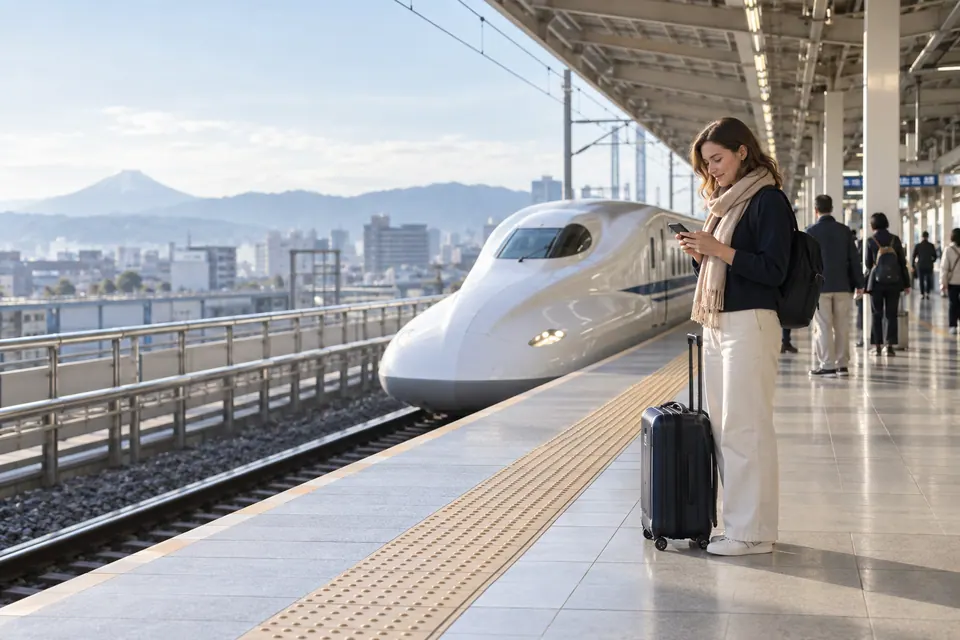
The trip in one view
If you are leaving soon, find your departure station, destination station and Shinkansen line first. Then check the train number and time on your booking against the live departure board. The word “Shinkansen” on a sign is a starting point, not enough to identify your train.
The practical sequence is below. One early decision is what you will show or tap at the Shinkansen gate. A transport IC card with money on it is not by itself a Shinkansen ticket. It can be the gate key only when an eligible reservation is linked to that card or device.
- Choose route
- Book the train
- Pick a seat
- Check luggage
- Find the gate
- Match car and seat
- Ride
- Exit or transfer
If you are at the station now, start with the station name, route and departure board. Do not choose a gate based on the word “Shinkansen” alone.
You can use this guide in order while planning, or jump to the section you need while traveling. If you already have a booking, start with paper, QR or linked IC, then the station and gate and your car and seat.
When the Shinkansen makes sense
The Shinkansen is an intercity train. It often makes a long trip simpler because the main city stations are connected by rail, but it is not automatically the right choice for every route. An ordinary train, bus or flight may fit a short journey, a lower budget or a different destination better.
Compare the whole trip: travel to the departure station, the actual Shinkansen service, and travel onward after arrival. A Shinkansen station may not be the city-center station with a similar name. Check the exact station shown in the operator’s search results before paying. For ordinary city and regional trains, use our How to Ride Trains in Japan guide.
Meet Japan’s Shinkansen
Japan does not have just one Shinkansen. Different routes use different service names — Nozomi, Hayabusa, Komachi, Sakura and more. A service name is the name shown when you book and on departure boards; it helps you identify a train and its stopping pattern. The good news: you do not need to memorize them all. Start with where you are going, then learn the names used on that route.

Names you may see on each route
Representative services, not every train or stopping pattern. You only need the names used on your route.
- Hokkaido
- Shin-Aomori → Shin-Hakodate-HokutoHayabusa · Hayate
- Tohoku
- Tokyo → Shin-AomoriHayabusa · Yamabiko · Nasuno
- Akita
- Tokyo → Morioka → AkitaKomachi
- Yamagata
- Tokyo → Fukushima → Yamagata / ShinjoTsubasa
- Joetsu
- Tokyo → NiigataToki · Tanigawa
- Hokuriku
- Tokyo → TsurugaKagayaki · Hakutaka · Asama · Tsurugi
- Tokaido
- Tokyo → Shin-OsakaNozomi · Hikari · Kodama
- Sanyo
- Shin-Osaka → HakataNozomi · Hikari · Kodama · Mizuho · Sakura
- Kyushu
- Hakata → Kagoshima-ChuoMizuho · Sakura · Tsubame
- Nishi-Kyushu
- Takeo-Onsen → NagasakiKamome
The map is an introduction, not a promise that every named service covers every station on its line. The Nishi-Kyushu Shinkansen is a separate stretch between Takeo-Onsen and Nagasaki. From Hakata, the current route uses a limited-express connection such as Relay Kamome to Takeo-Onsen before the Kamome Shinkansen; check your actual itinerary and transfer. JR Kyushu explains the connection.
Train name or train model?
Nozomi is a service name, not a type of vehicle. N700S is a train series used on the Tokaido route. Likewise, Hayabusa is a service name, while E5 names a train series. For travel, your route, train number, time and stops matter more than memorizing vehicle models. JR Central and JR East show those distinct names.
A small railway surprise: some Hayabusa and Komachi trains travel together and separate at Morioka, heading toward different destinations. If your ticket says Komachi, follow its car and train number rather than the name on the other half of the coupled train. JR East describes the operation.
Several JR companies operate the network, so booking is not handled by one nationwide website. Tokyo–Kyoto–Osaka is in the Tokaido/Sanyo corridor, where SmartEX is one official option; Tokyo–Sendai and Tokyo–Nagano have relevant JR-EAST Train Reservation products. Search your route and operator. If a website does not find your train, a relevant JR station machine or ticket counter can help.
These are route-finding examples, not a universal map of booking coverage. Confirm your actual origin, destination and train with the operator.
Where to buy or book
You can buy through a relevant JR station’s reserved-seat machine or ticket counter, or use the official online service that covers your route. If you are at a station, bring the departure and arrival station names, date, preferred departure time, number of adults and children, and any seat or luggage need to the machine or counter.
Online booking is useful when you want to secure a seat before travel. It also means following that service’s rules for membership, payment, boarding and changes. A station purchase can be easier if your card is declined or the online route is not supported. Check what a particular machine accepts before relying on a payment method; do not assume every machine uses the same screen or cards. JR East’s ticket guide explains its options.
SmartEX for the Tokaido–Sanyo–Kyushu corridor
Applies to: SmartEX bookings on the Tokaido, Sanyo and Kyushu Shinkansen.
SmartEX lets you book on its covered routes. Its standard booking combines the basic travel fare and Shinkansen charge. Check the selected train, seat type and conditions before payment; a discounted Hayatoku product can have stricter change and missed-train rules than the standard product. Read the SmartEX service terms.
Registration and a supported payment card are required for online use. The official app is distributed in specified store countries or regions; availability on your phone is not a reliable test of whether you can take the train. If the app is unavailable, try the official website or buy at a station. Card registration can also fail because of issuer authentication, so leave a station option in your plan.
SmartEX can use an eligible boarding QR, an associated transport IC card or a collected paper ticket, depending on how you set up the booking. Decide which one you will actually present before arriving at the gate. Some standard reservations can be changed before the booked departure and before gate entry or ticket pickup, subject to product conditions; check the official change rules for yours.
JR-EAST Train Reservation and e-tickets
Applies to: JR-EAST Train Reservation Shinkansen e-tickets on supported routes and fares.
For a supported JR East Shinkansen trip, you can reserve an e-ticket and link it to a compatible transportation IC card or device. Each person needs their own assigned IC card when that boarding method is used; one family card cannot open the gate for everyone. The reservation, not the stored IC balance, gives that traveler the Shinkansen right to ride. JR East explains the e-ticket process.
If your group does not have suitable cards, check the paper tickets and pickup methods offered for the selected route. Do not try to turn a QR pickup code into a gate ticket unless the service explicitly calls it a boarding QR. The separate Suica & IC Cards guide covers obtaining, charging and managing cards; this section covers the Shinkansen booking.
A booking checklist before you pay
Read the purchase summary one last time. Does it show the exact stations, travel date, train number, departure time, passenger count, and the seat category you intended? If you have a large suitcase, confirm the baggage-space choice now; it may not be something you can fix on the platform.
Next, read the boarding instructions. Write down whether each person will use paper, a boarding QR, or a particular linked IC card or device. Save the booking number and official confirmation in a place you can reach without internet. For a family, assign each traveler’s ticket or linked card before the queue at the gate.
Paper, QR or linked IC: what opens the gate?
Applies to: SmartEX for the QR and linked-IC examples below; other services may use different gate steps.
A paper ticket goes into the appropriate ticket slot. Keep every piece the gate returns. Some products produce more than one piece, and an ordinary-train transfer can have its own ticket or IC step. Follow the instructions printed with your purchased product, not a generic “two tickets every time” rule.
For SmartEX QR boarding, use the actual QR ticket for the individual seat at a QR-marked gate and keep it for exit. SmartEX also issues a Seat Information slip at entry; take it, but do not insert that slip as a gate ticket. Its guidance allows print and supported wallet/display methods, yet warns that some devices may not scan, so a printed QR is a sensible fallback where its instructions recommend one. A pickup code is not the boarding QR. See SmartEX’s QR guide.
For linked-IC boarding, first associate the eligible card or device with the actual reservation, then use the card assigned to that traveler. On SmartEX, the Shinkansen booking is paid from the registered payment card, not deducted from the IC card’s stored value. A conventional-line transfer gate may need both your local-line medium and Shinkansen booking method. See SmartEX’s linked-IC instructions and the rules for your own service.
| Ticket or booking | At the gate | Keep for exit |
|---|---|---|
| Paper | Insert the required ticket piece or pieces. | Take returned pieces and keep them. |
| Eligible QR | Scan the actual boarding QR at a marked gate. | Keep the QR; collect any seat-information slip. |
| Linked IC | Tap the card or device assigned to this traveler. | Use that same card or device; collect any seat-information slip. |
A pickup QR, a seat-information slip and a boarding QR are not interchangeable. Local-line transfers may add another ticket or IC step.
Why a ticket may show two kinds of fare
Shinkansen travel conceptually includes a basic fare for the journey and a Shinkansen limited-express charge for the fast train. A reserved seat or Green Car can affect the charge. The operator may issue one combined ticket, multiple paper pieces, or an electronic reservation; the number of pieces in your hand does not tell you by itself whether the whole trip is covered. JR East’s ticket guide separates these fare layers.
Your purchase might show these on one ticket, multiple paper pieces or an electronic booking. Check what your purchase actually includes, especially ordinary-train connections.
Check ordinary-train connections too. The SmartEX standard product covers its booked Shinkansen section, while a conventional train to or from that station may require a separate fare. If the gate rejects a ticket, show all ticket pieces and the booking confirmation to staff instead of buying another ticket by guesswork.
Buying at the station, step by step
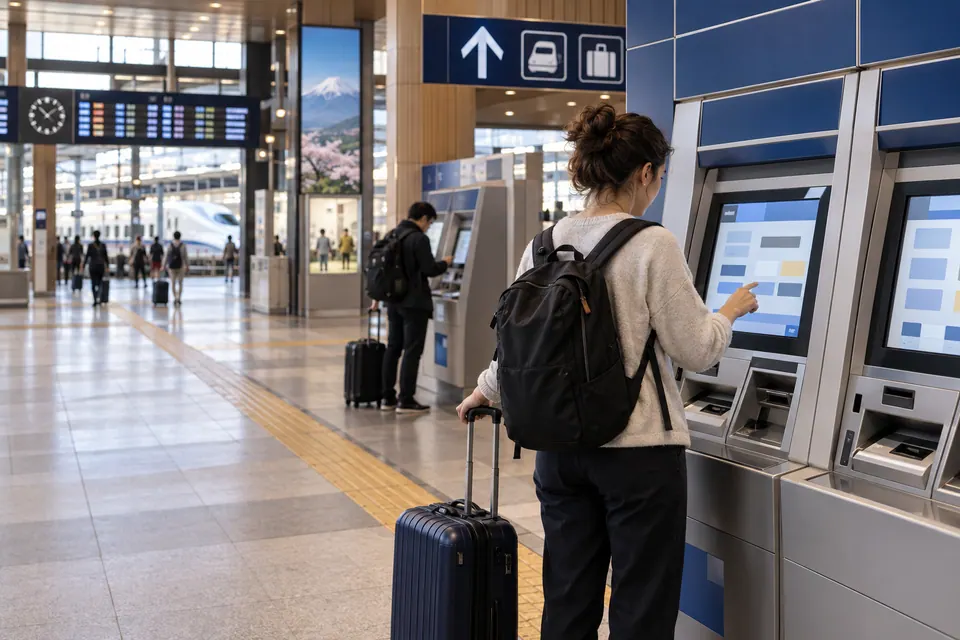
Look for a reserved-seat ticket machine or staffed JR ticket counter that sells your route. Choose the departure and arrival stations, date, train, seat type and passenger count. The machine may offer a seat map, but interfaces and language options vary. Read the total and the included journey before paying.
Collect all tickets, receipt or booking details, and check the printed train number, time and seat. If a child is traveling, select the correct child product rather than assuming an adult booking will work at the gate. If you need oversized-baggage space, ask for the eligible seat while buying, not after reaching the platform. A staff member can help identify the right product if the machine does not show what you need.
Reserved or non-reserved?
A reserved seat gives you a specific train, car and seat. It gives more certainty for a group, a busy travel date or a luggage-space requirement, but you must watch the conditions if plans change. A non-reserved ticket lets you use an eligible non-reserved car under that ticket’s rules; it does not guarantee an empty seat, and it is not offered on every train or every date.
| Seat | What you receive | Check before buying |
|---|---|---|
| Non-reserved | Use of an eligible non-reserved car; a seat is not guaranteed. | Does this train offer one today? |
| Reserved | A specified train, car and seat. | Change and missed-train terms. |
| Green Car | A premium reserved seat on trains that offer it. | Extra charge and included amenities. |
Check the exact service before choosing. JR Central announces periods when Nozomi is all-reserved. Other all-reserved trains exist on different routes. Do not assume the next Shinkansen has a non-reserved car.
Green Car and other premium seats
A Green Car is a premium seat option on trains that offer it, usually with more room and a higher total fare. It is still a specific ticket or fare choice: check the train, car, seat and what the fare includes. More comfort does not automatically mean a meal, a lounge or onboard sales.
Some JR East services offer GranClass, another higher-class product with train-specific conditions. Do not compare a premium label across operators as though it promises identical amenities. A future premium service announced by an operator should not be treated as available until its start date and actual service are confirmed.
Train names tell you about stops
The network overview shows which service names belong to your route. Now check the actual stop list. On the Tokaido section, Nozomi serves major stations with the fewest stops, Hikari has an intermediate pattern, and Kodama stops at every station. The name gives you a clue, but the train number and your destination decide whether it is yours. JR Central explains the three services.
Not every Shinkansen stops at every Shinkansen station. Match the train number, departure time, destination and stop list on the official booking and station display. A fictional example below shows the idea, not a real timetable. Changing from a Kodama or Hikari to a Nozomi is only necessary if your booked itinerary actually calls for that transfer.
| Example | Station A | Station B | Station C | Station D |
|---|---|---|---|---|
| Fewer-stop train | Stops | Passes | Passes | Stops |
| More-stop train | Stops | Stops | Stops | Stops |
Nozomi, Hikari and Kodama are Tokaido examples. Compare the actual train number, destination and stop list before boarding.
Scenic tip: Mount Fuji
On a Tokaido trip near Mount Fuji, the mountain is generally on the right when heading from Tokyo toward Shin-Osaka, and on the left in the reverse direction. A seat on that side improves your chance of a view, but daylight, clouds and the exact train matter. The mountain still gets the final say. Check the current seat layout before choosing, especially if you also need an oversized-baggage seat. JR Central’s route guide shows the viewing side; its baggage guide explains the separate reservation requirement.
Using a JAPAN RAIL PASS
Applies to: The nationwide JAPAN RAIL PASS; regional passes have separate terms.
Check which pass you hold and which train you want. A nationwide JAPAN RAIL PASS covers eligible JR services, but it does not cover every Shinkansen service without another step. Seat booking procedures and coverage differ from the ticket you would buy without a pass. Regional passes have their own boundaries. A pass is worthwhile only if your actual itinerary justifies its price.
The important exception is Nozomi and Mizuho: the nationwide pass alone does not cover them, but an advance special NOZOMI MIZUHO Ticket can allow pass holders to use those services under the official rules. Buy the required extra ticket before boarding. Do not board on the assumption that the pass by itself is enough, and confirm any baggage-space reservation separately.
Find the right station and gate
Before leaving your hotel or transfer train, compare the full station name on the booking with the one in your route search. Some city areas have both an ordinary central station and a separately named Shinkansen stop. At the station, look for the Shinkansen departure board and check your train number, time, destination and platform.
Follow signs toward a Shinkansen gate or transfer gate for your operator and route. If you first entered a conventional-line paid area, do not assume a direct Shinkansen gate will use the same sequence as a transfer gate. Keep your local-line card or ticket as well as the Shinkansen booking accessible. Leave enough time to walk and ask a question without running; the walk can be longer than the platform sign first suggests.
Pass the gate with the correct item
Approach a gate that accepts the ticket, QR code or linked card shown in your booking. For paper, insert the required ticket piece or pieces and take back what the gate returns. For SmartEX QR, use a marked QR gate, collect the Seat Information slip, and keep the QR for exit. For a linked IC product, tap the exact card or device assigned to that traveler and collect any slip the service issues.
At a transfer gate, the ordinary-line ticket or IC card may have to be used in addition to the Shinkansen ticket or booking, in a service-specific order. SmartEX documents its QR transfer combinations and IC combinations. If the gate stays shut, step aside with your whole group, then show staff the booking and all cards or tickets you used. A gate error is easier to solve before anyone tries a different card or code.
Find your car, queue and seat
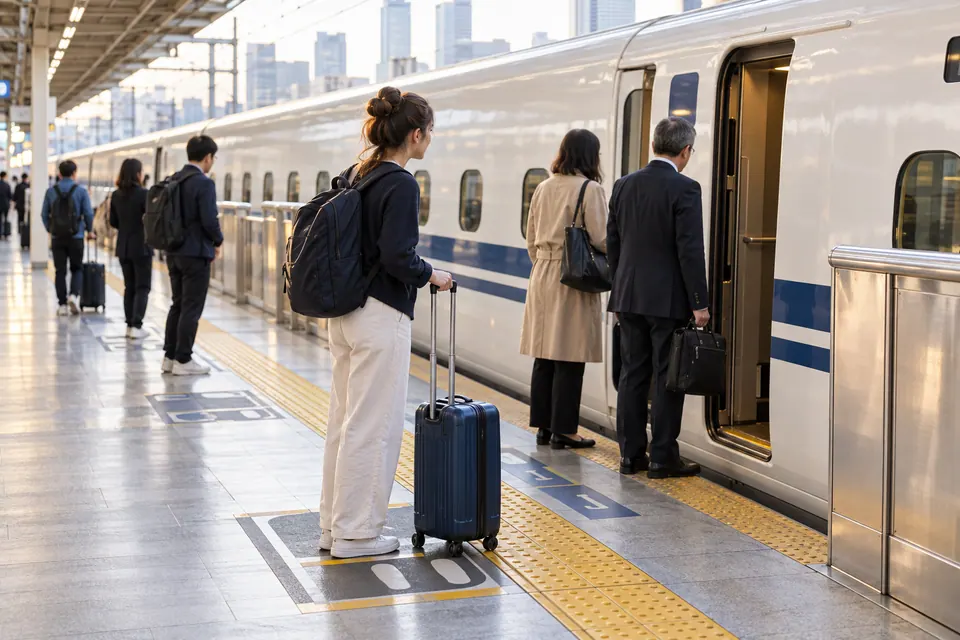
On the platform, check the train number and departure time again. Then find the car number printed on your booking and the matching boarding-position marker. Reserved and non-reserved cars are identified separately. A seat such as “Car 7, 12A” belongs to a particular car; “12A” alone will not get you to the right door.
Wait behind the safety line and let passengers leave before you board. Once inside, use the seat numbers above or beside the rows. If someone is in your booked seat, show the reservation politely and ask the conductor for help if the situation is not clear. Do not occupy a premium or reserved car simply because it looks empty.
Measure large luggage before travel
Applies to: Tokaido, Sanyo, Kyushu and Nishi-Kyushu Shinkansen.
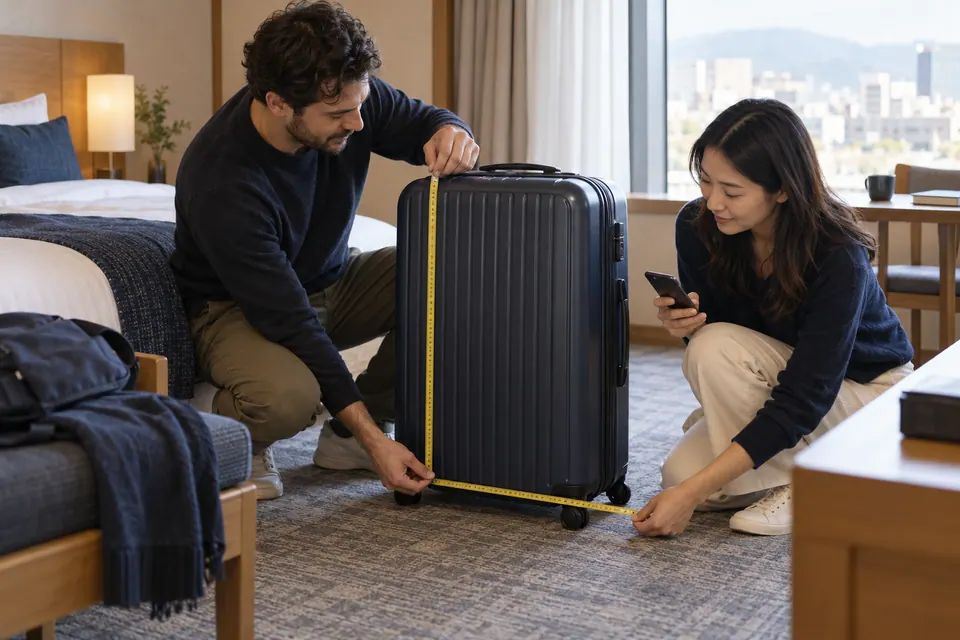
Big suitcase? Measure it before you reach the platform. On these routes, JR Central’s luggage guidance says to add height + width + depth, including protruding parts. A total up to 160 cm uses ordinary storage if it fits safely. A total over 160 cm and up to 250 cm needs an eligible reserved seat with oversized-baggage space. A bag over 250 cm is not accepted under the checked rule.
- Up to 160 cmOrdinary storage, if it fits safely. No oversized-space reservation under the checked JR Central rule.
- Over 160 cm and up to 250 cmOn the covered western routes, reserve an eligible seat with oversized-baggage space before travel.
- Over 250 cmNot accepted on those routes under the checked rule. Arrange another way to move it.
These thresholds are the checked JR Central rule for the Tokaido–Sanyo–Kyushu/Nishi-Kyushu corridor, not a nationwide rule. Special items and current trial deck spaces have separate conditions.
Reserve the eligible baggage-space seat when buying. The checked JR Central rule says there is no extra seat surcharge solely for that reservation, but boarding with oversized baggage without the required reservation can incur a ¥1,000 baggage fee and staff will direct storage. Do not treat the space behind the last row as public luggage space. Some deck storage is being trialed under separate conditions, and strollers, sports equipment and musical instruments have stated exceptions. Check the operator’s rule for a different Shinkansen route.
Where an ordinary bag goes
A bag that fits can go on a suitable overhead rack or in the space at your feet without blocking another passenger, the aisle or the door. On the checked JR Central route, some deck storage areas exist, but availability and rules depend on the car. Heavy bags can be awkward to lift; ask staff where an item may go if you cannot stow it safely.
Keep your luggage under your control and do not take a rear-seat baggage area unless your booking grants it. If a stroller or unusual item needs a special space, read the operator’s conditions before you travel. The JR Central luggage page explains its storage choices and exceptions.
Would sending the suitcase be easier?
If the bag is too large, too heavy or simply difficult to carry through a transfer, a luggage-delivery service may be an alternative. JR Central points to a paid luggage-delivery option on its travel-information page. Hotels and delivery operators may also offer arrangements, but acceptance, cutoff times, destination coverage and arrival time vary.
Ask your accommodation or the operator before sending anything you need that day. Keep passports, medicine, tickets and other essentials with you. This is a convenience choice. Check the baggage rule for your actual train even if you send part of your luggage ahead.
Food, drinks and ekiben
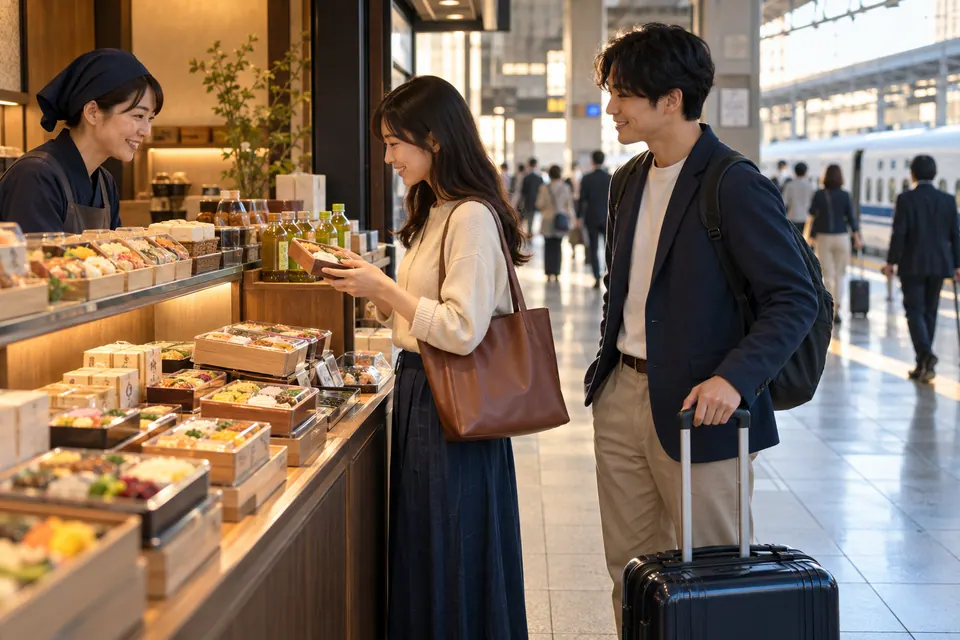
Eating a meal on a long-distance Shinkansen is normal. An ekiben is a boxed meal sold for train travel; a station shop may also have sandwiches, snacks and drinks. If you definitely want lunch or a drink, buy it at the station before boarding. An ekiben and a window seat make a pretty good travel plan.
Keep the tray, wrapper and drink stable while the train moves, and take your trash to the available bin or off the train if needed. Check the platform and boarding time before you disappear into a food shop. A full meal is less relaxing when you are sprinting for the correct car.
Onboard sales, Wi-Fi, power and toilets
Applies to: JR Central’s Tokaido sales and train-equipment examples; check your own route for services.
Do not count on onboard food sales. They vary by route, train and class. JR Central’s Tokaido guidance says ordinary-class food and drinks are not sold onboard and describes mobile ordering for eligible Green Car services. If you want food or a drink, buy it at the station before boarding.
Wi-Fi and power outlets also depend on equipment. JR Central describes Wi-Fi on its stated services and outlet differences between train models and seats. Save critical booking details offline and bring a charged phone or power bank. Most trainsets have toilets, but their location and accessible features vary; check the car map or ask staff rather than promising a feature at a particular seat.
If you miss your Shinkansen
Applies to: SmartEX for the example below; other services and fares have different rules.
Missed your Shinkansen? First, don’t panic. What you can do next depends on the ticket or fare you bought. If your plans changed before the booked departure, check whether your service still lets you change the reservation, and act before entering the gate or collecting a paper ticket if those steps restrict changes.
If it has already left, open the booking conditions or show the ticket to staff before boarding another train. SmartEX says an eligible standard booking may allow a later same-day train’s non-reserved seat over the same section; its Hayatoku fares are excluded, and a later train may have no non-reserved car. Other operators, tickets and fares have different rules. A baggage-space booking makes guessing especially risky. “Just take the next train” is not a universal rule.
Wrong train, lost ticket or dead phone
Wrong Shinkansen? Show your reservation to the conductor promptly. Ask which stop you should use and whether you need another ticket or fare adjustment. Do not leave the train except at a normal stop, and do not assume a free correction or a guaranteed connection. If you are still on the platform, ask station staff before boarding.
If your paper ticket is missing, go to a staffed gate or counter with any receipt or booking record. Replacement and possible later refund handling depend on the ticket and operator; you may have to buy another ticket. If a SmartEX QR or linked phone/card is unavailable, open the official reservation if you can, then ask staff for the service’s permitted alternative. SmartEX has recovery guidance for a lost QR or card; do not rely on a screenshot, pickup code or a companion’s card without checking that it is a valid way for you to board.
Delays, cancellations and getting out
If a train is delayed or canceled, read the current operator display and service notice before changing a reservation or boarding a different train. Keep your ticket, QR or linked card ready. Change and refund handling depends on the cause, product and stage of travel; the station counter or booking service can tell you which choice is valid for this journey.
At your destination, use the same ticket, QR code or linked card for the exit, unless your operator’s instructions say otherwise. Keep paper pieces and QR tickets until the journey is complete. A transfer to an ordinary line may require another fare or a particular gate sequence. Pause beside a staffed gate if the system returns something unexpected; it is better to ask than to discard a ticket you still need.
Useful Japanese on tickets and signs
You do not need to memorize a script. These words help you recognize the right seat, car or disruption notice, and you can show the actual booking to staff. Romanization remains part of the Owner language review for this new page.
These signs help you recognize a ticket or display. Check the current operator signs and staff directions.
- 新幹線
- しんかんせん · shinkansen
Shinkansen / bullet train - 指定席
- していせき · shiteiseki
reserved seat - 自由席
- じゆうせき · jiyūseki
non-reserved seat - グリーン車
- グリーンしゃ · gurīn-sha
Green Car - 号車
- ごうしゃ · gōsha
car number - 乗換
- のりかえ · norikae
transfer - 遅延
- ちえん · chien
delay - 運休
- うんきゅう · unkyū
service canceled / not operating - 払戻し
- はらいもどし · haraimodoshi
refund
To ask whether you need an extra ticket, the existing Show This Screen phrase can help. Show your actual reservation as well.
Questions first-time riders ask
Do I have to reserve a Shinkansen seat?
Can I buy a ticket on the day?
Which official booking site should I use?
Can I tap my Suica balance to ride the Shinkansen?
Do I need two paper tickets?
What is the difference between reserved and non-reserved?
What is a Green Car?
Does every Shinkansen have non-reserved seats?
Can I use a JAPAN RAIL PASS on Nozomi?
How early should I get to the station?
Where should my suitcase go?
Can I eat on the Shinkansen?
Is there Wi-Fi or a power outlet?
What if I miss my reserved train?
What if I board the wrong Shinkansen?
Do children get a lower fare?
What if my phone battery dies or I lose my QR ticket?
What if my paper ticket is lost?
Sources & checks
Sources checked 25 Sept 2026. For changing details, confirm with the responsible organization.
- SmartEX · Service scope and fare productTokaido/Sanyo/Kyushu service scope; combined fare and express charge; seat products; ticketless options · SmartEX product terms are not a rule for JR East or for every discounted fare.
- SmartEX · App distribution regionsApp store availability differs by country or region · Check the current official list; website and station purchase remain alternatives.
- SmartEX · QR boardingQR-marked gate, individual QR ticket, exit scan, seat-information slip and device caveats · A QR pickup code or arbitrary screen image is not automatically a boarding QR ticket.
- SmartEX · Linked IC boardingRegistered IC card as boarding key; booking is paid from registered card, not IC stored value · Conventional-line transfers have additional gate steps.
- SmartEX · Missed reserved trainLater same-day non-reserved use for an eligible standard product and Hayatoku exception · Never apply this recovery rule to every ticket or service.
- JR East · Shinkansen e-ticketJR-EAST Train Reservation, one linked transport IC per traveler and paper pickup alternative · Scope and linking procedure belong to JR East service conditions.
- JR East · Tickets and purchasesBasic fare and express charge; station and online ticket options · Station facilities and accepted payment methods differ.
- JR Central · Nozomi peak-period seatsNozomi can have all-reserved seating in announced peak periods · No fixed future peak calendar is reproduced in this guide.
- JAPAN RAIL PASS · Nozomi/Mizuho special ticketOrdinary nationwide pass alone excludes Nozomi/Mizuho; a separate special ticket can permit travel · Regional passes and booking windows require separate checks.
- JR Central · Luggage and oversized baggageThree-side measurement, 160/250 cm thresholds, reserved space, current unreserved fee and exceptions · Route-specific; some deck spaces are in a trial arrangement.
- JR Central · Adult and child ticketsAge and school-year child categories and seat-dependent treatment · Premium supplements and special products need their own fare check.
- JR Central · Tokaido Shinkansen food guidanceStation food and route/class-specific onboard sales · Do not generalize a Tokaido onboard-sales example to every train.
- JR Central · Train facilitiesOutlets and car equipment vary by train model and seat · Do not promise an outlet at every seat.
- JR Central · Onboard Wi-FiWi-Fi availability on the stated Tokaido/Sanyo/Kyushu services · Equipment and connection performance vary.
Fares, booking products, seats, baggage rules and disruption procedures can change. Check the exact train and product with its operator before travel.