
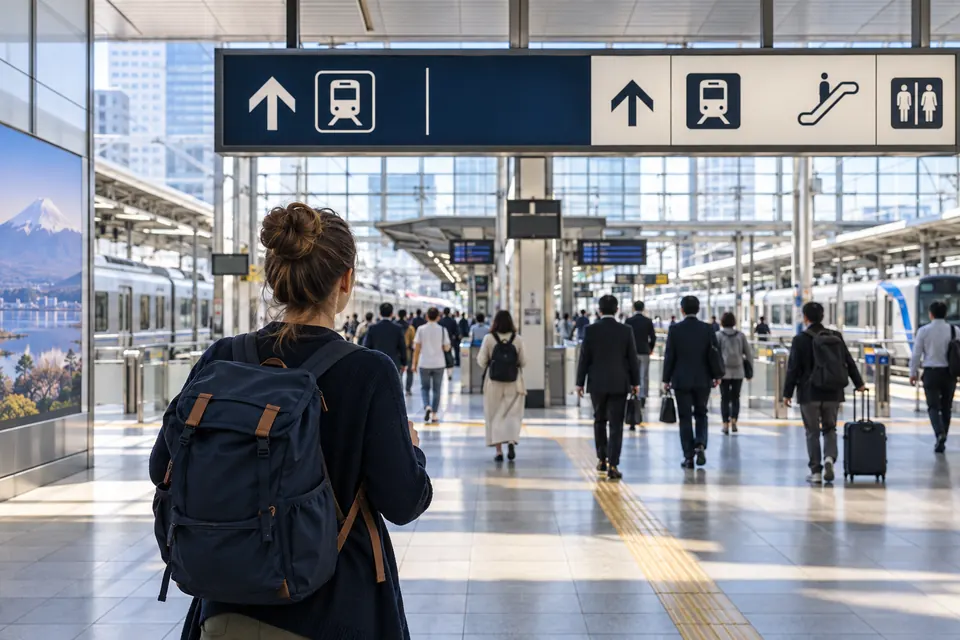
The whole trip at a glance
You do not need to master Japan's rail network to take one ordinary train. Find your destination and line, pay the basic fare, then check the direction and train before boarding. Repeat those small checks at a transfer. Each step gives you one clear thing to look for.
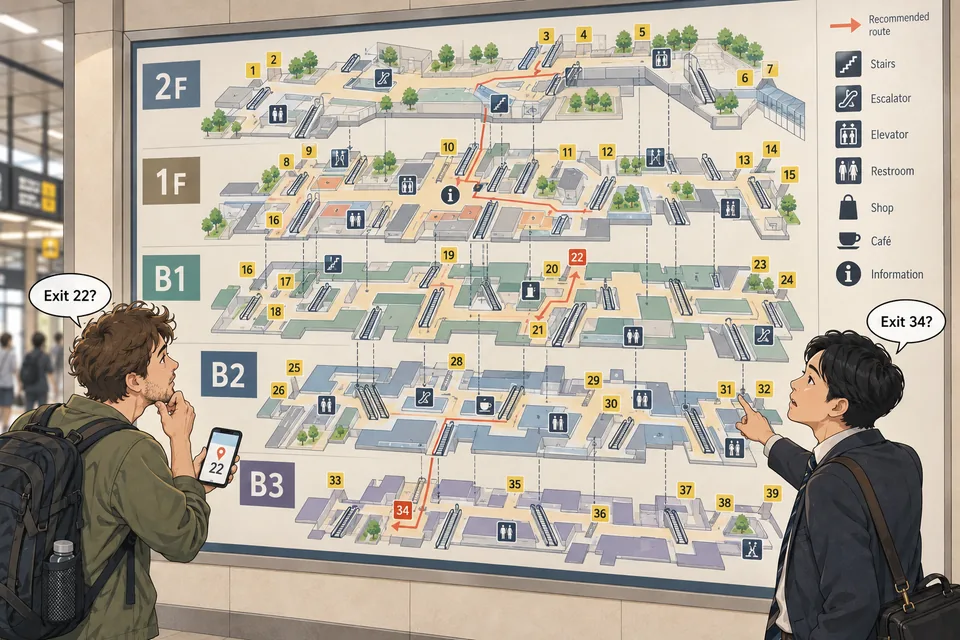
- Plan the route
- Choose how to pay
- Enter the gate
- Find the platform
- Check the train
- Board and ride
- Transfer if needed
- Exit the gate
Keep your destination visible on your phone or paper. You only need to solve the next check.
If you are already standing in a station, keep your destination station visible on your phone. Start with the railway company and line, not an exit number. A platform number is useful only after you know the direction and train type. Tokyo Metro's boarding walkthrough shows this sequence for its subway network.
Before you enter the station
Before you head to the gates, keep five details handy: your destination station, the line, the direction or train destination, any transfer station, and the departure you expect to take. A route search can assemble those details; recheck the live station display because platforms and services can change. JR East offers route search and train status for its network, and Tokyo Metro offers fare and transfer search for its lines.
Take the displayed departure time seriously. For a 10:04 train, aim to reach the platform a few minutes early. Tokyo Metro explains that its listed departure time is when the train starts moving; the doors close before then. Be ready to board before the displayed time. Delays still happen, so check the live display too.
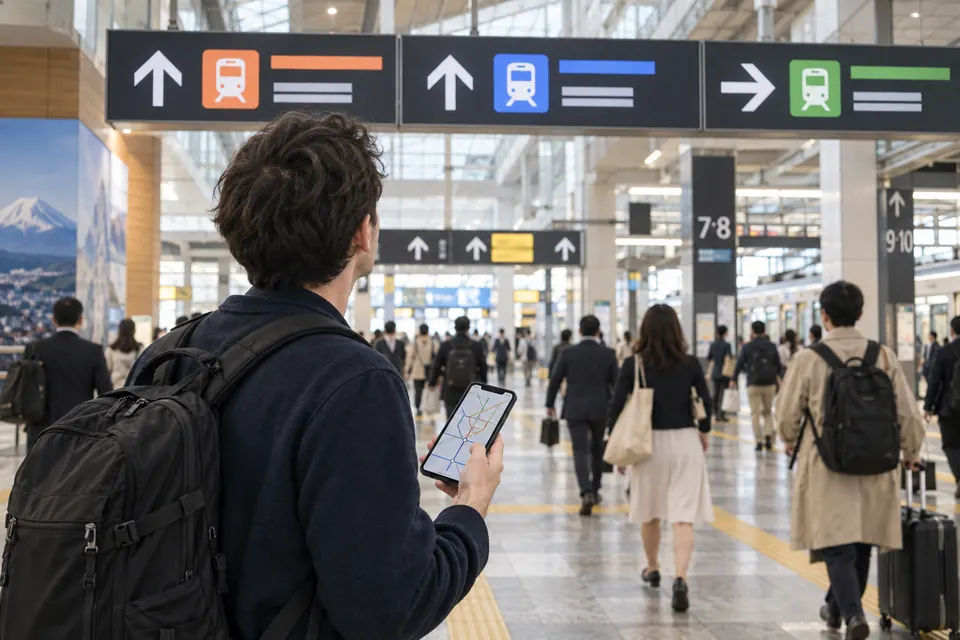
One large station can serve several railway companies. A map pin for “Tokyo Station” does not mean every train uses the same gate. First look for the operator and line name on the overhead signs. If your route search says JR, do not follow signs for a subway line just because both have a platform numbered 1.
Use station names, line colors and numbers
Many urban systems show a line symbol or color with a station number. Tokyo Metro advises remembering the station name, number and line color together. The number can be a handy second check when a station name is difficult to pronounce, but colors and numbering systems belong to their own networks. Tokyo Metro explains its station numbering and signs.
Do not follow a color alone. Match operator → line → direction → station. On a route screen, save the destination in English or Japanese so you can compare it with signs or show it to staff. For a quick platform-only refresher, see the five checks for finding your train.
IC card or paper ticket?
For an ordinary journey, you will usually enter with an accepted transport IC card or a paper ticket. An IC card is convenient because the fare can be calculated as you travel. No IC card or phone ready? A paper ticket is a normal option. It can also help when a particular route needs different ticket handling. You do not need Suica to take an ordinary train.
This is a basic journey model. Passes, special tickets and transfer gates can have different handling.
Check that the operator and route accept your card; a card that works on one part of a journey is not automatically valid everywhere. The Suica & IC Cards Complete Guide handles buying, charging, phone compatibility, refunds and IC-card trouble. This page stays with what you do at the station.
Buy a paper ticket step by step
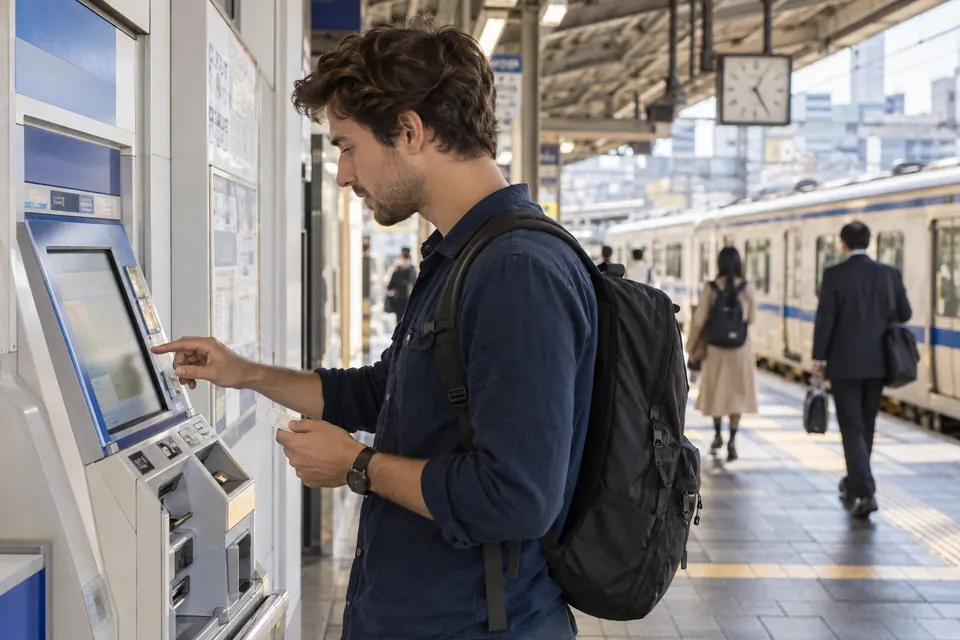
At the correct company's gate area, look for a ticket vending machine. Check your destination and fare on the station fare map, the operator's route search, or the machine itself. Some machines let you select a station name; others ask for a fare amount. Tokyo Metro's machines have an English-language option and can search by station name or number, but another operator's screen may differ. See Tokyo Metro's machine walkthrough.
Choose the ticket for your trip, pay using the methods that that machine accepts, then collect the printed ticket and any change. Before leaving the machine, check that you are holding a ticket for the intended journey rather than a receipt. Do not assume every regular-ticket machine takes a credit card; Tokyo Metro says its standard regular-ticket purchase uses coins or bills. If the destination or ticket type is unclear, show your destination to station staff before buying.
Children's fares depend on age and operator. Some young children travel free when accompanied; others need a child fare. Check the operator's fare-by-age rules before buying for a family. Every fare-paying traveler needs their own valid ticket or accepted card at the gate.
If you do not know the fare
Try the operator's route or fare search first. At a Tokyo Metro machine, you may be able to search by destination station instead of reading the entire fare map. If the fare is still unclear, show the station name at a staffed gate or ticket counter and ask which ticket to buy. Tokyo Metro documents both methods.
If you later discover that a regular Tokyo Metro ticket was too cheap for the distance traveled, its fare-adjustment guidance directs you to a machine near the exit gates. Other companies have their own processes. Do not deliberately buy an underpriced ticket as a general plan. If you are unsure, ask before entering or speak to staff at the destination.
Go through the ticket gate
For an accepted IC card or phone, tap the marked IC reader and wait for the gate to accept it. Keep using the same card or device for the trip and its exit. If the gate says no, step aside rather than tapping repeatedly. The IC-card gate problem guide explains the recovery steps.
For an ordinary paper ticket, insert it into the ticket slot, walk through, and take it back from the machine at the other end. You need it later. At your destination, a normal single-journey paper ticket is usually retained by the exit gate; passes and special tickets may be returned. Tokyo Metro's entry and exit instructions show that distinction.
For a normal single-journey paper ticket, take it at entry and keep it for the exit. Do not leave it in the gate.
Pause at the side if you are handling a bag, a child or more than one ticket. Let the people behind you pass while you check which item belongs to which traveler. If the ticket is rejected, step aside and ask station staff rather than trying to force the gate.
Find the platform that serves your train
Inside the gates, read the departure board for the line, direction, train type, departure and platform. Follow the platform signs, then check the display on that platform again. A platform can serve several departures. Being on the right platform does not always mean the next train is the one you want. Tokyo Metro tells riders to compare the line, direction, station names and platform number on the signs. Its boarding guide shows what to look for.
If your route suggests a particular car for an easy transfer, treat that as a convenience after you have confirmed the train. The right service matters more than the “best” door position. At a large station, allow time to walk between platforms without running.
Local, Rapid, Express and Limited Express
Train categories tell you how often a train stops, but the labels are not used exactly the same way by every railway. Local or 各駅停車 generally stops at every station on its route. Rapid or 快速 may pass some stations. Express or 急行 can be faster again on some operators. Limited Express or 特急 often has a separate fare or seat rule. The same English label can be used differently by another railway.
Not every train stops at every station. Check your destination in the actual stop list before boarding, even when the train is on the right line. JR East's ticket guide separates local/rapid basic-fare travel from limited-express ticket layers; the exact service and ticket rule remain operator-specific.
| Example service | Stop A | Stop B | Stop C | Stop D |
|---|---|---|---|---|
| Local | Stops | Stops | Stops | Stops |
| Rapid | Stops | Passes | Stops | Stops |
The names and actual stop lists differ by operator. Check your station on the real departure board or route display.
Does this train stop at my station?
Look first at the platform or departure display. Compare the train's type, destination and listed stops with your route. A destination on the front of a train tells you where it is headed, not every place where it will stop. If the board shows only key stations, check the operator's route display or ask staff whether this departure stops at your station.
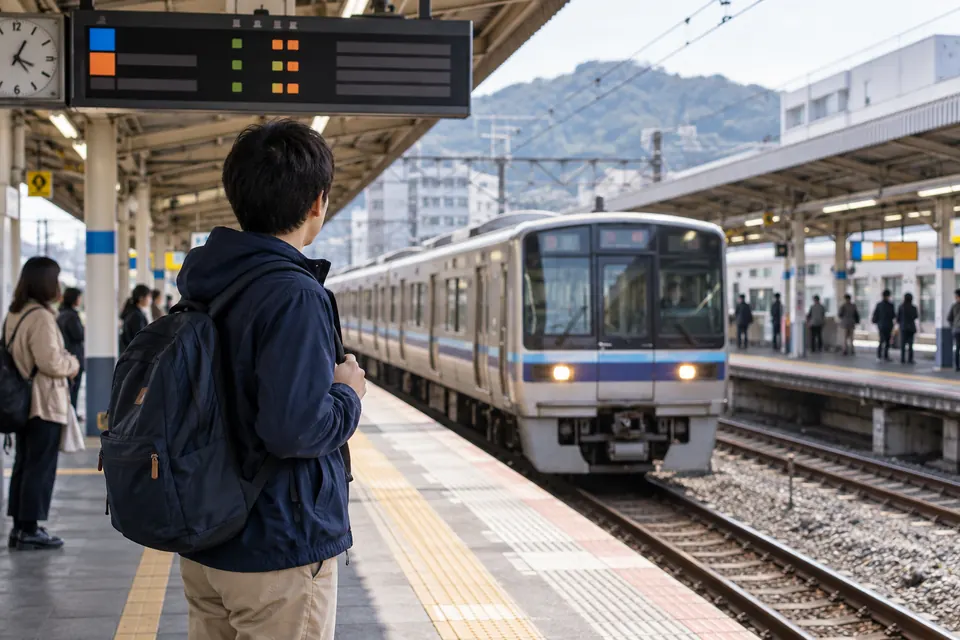
If two trains share the platform, wait for the one matching your route. When the display and a route app disagree, the live operator information and station staff are the safer checks. The short platform guide is designed for this exact moment.
Which direction should I travel?
Look for a platform sign showing the train's destination or terminal station. Match it to the direction in your route, then check the next few stations on the line diagram. “Inbound” and “outbound” can be less useful to a first-time visitor than the place name printed above the platform. On a loop line, follow the direction and upcoming stations rather than assuming that one color means one way.
If you can see your own destination on the opposite platform's stop list, pause and compare before you descend or cross over. The line can be right while the direction is wrong. One more look at the upcoming stations can save a detour.
Board the train
Stand behind the marked safety boundary and use the platform's waiting lines where provided. Let passengers get off first, then board without rushing. If the doors close before you reach them, wait for the next service rather than trying to force your way in. Tokyo Metro's boarding advice explicitly asks passengers to wait behind the warning blocks and not rush.
Move away from the doorway once on board when space allows. Priority seats are for passengers who need them; offer a seat when someone needs it more. A bag on your shoulder can feel much larger in a crowded carriage than it did in the station hall.
While you ride
Watch the next-station display or listen for announcements, especially near a transfer. Tokyo Metro notes that onboard displays can show the current and upcoming stations. If you are tired or the carriage is crowded, set a reminder for one stop before yours and confirm the station name as the train arrives. The operator's guide illustrates onboard information.
On a commuter train, keep your voice low and your phone quiet. Tokyo Metro asks riders to silence phones and avoid calls. Food and drink expectations can differ between commuter services and long-distance trains, so follow any posted rule and use common sense about mess and space. Hold or stow luggage so the doors, aisle and priority seating stay usable. This is practical shared-space advice, not a test of perfect etiquette.
Change trains without losing the route
At the transfer station, find the signs for the next railway company and line. Follow them, then make a new platform check: direction, service type and departure. A transfer might be across the platform, down a corridor, or through a separate gate. Do not assume that staying in the same building means staying inside the same paid area.
- Get offFind the next company and line on transfer signs.
- Check the gateSome transfers stay inside; others use a special or ordinary gate.
- Recheck the trainMatch direction, service and platform before boarding again.
Follow the signs for your particular interchange. Do not assume every transfer uses the same gate rule.
Tokyo Metro says some of its transfers use special orange gates while others do not require leaving the gates; its own ticket and timing rules apply to those locations. Its transfer instructions are useful examples, not a universal rule for JR or other railways. At a different operator's gate, check the signs and your ticket type. If you cannot tell whether to exit, ask staff before feeding a paper ticket into an ordinary exit gate.
Check whether this train needs another ticket
A basic fare, paper ticket or accepted IC tap may be all you need for an ordinary local journey. A limited express, reserved seat, Green Car or Shinkansen can need an additional ticket, reservation or surcharge. Some trains require more than the basic fare. “Express” and “Limited Express” are not interchangeable terms across operators.
JR East's ticket overview shows a basic-fare layer and a separate limited-express layer. Before boarding an unfamiliar service, ask which ticket is required for that train and seat. Our extra-ticket problem guide gives the short decision path. Long-distance and Shinkansen booking are outside this ordinary-train guide.
If you boarded the wrong train
Wrong train? Annoying, yes. Disaster, no. Check the onboard display to see where you are headed. Get off at a safe, convenient next station and check your destination against the current line and direction. If a train skipped your stop, look for the appropriate local service or ask the staff how to continue.
Do not assume you can change direction through any gate without a fare adjustment. The correct fare treatment depends on the operator, route and ticket. If you are uncertain, go to a staffed gate before exiting and explain where you boarded and where you meant to go. Keep the ticket or the card/device you used for entry ready.
If you went past your stop
Get off at the next station where the train stops. Check a route back, including the train type and direction, before boarding again. On a rapid service, the next stop may be farther away than you expect. Take a moment to confirm the actual stopping pattern rather than reflexively crossing to the opposite platform.
Do not assume the extra ride is automatically free or that the gate will fix itself. If your ticket or IC card produces an unexpected fare or rejected exit, speak to station staff and give them the full path you traveled. The operator decides the correct treatment for that journey.
If the gate will not open
Step to the side so other travelers can pass. For a paper ticket, check whether you used the right gate and kept the ticket returned at entry. If the fare is short, follow the operator's fare-adjustment process or ask staff; Tokyo Metro has machines near its exit gates for this. Its getting-off guide shows the procedure.
For an IC card or phone, do not keep tapping or switch to a second card halfway through. Show staff the message and the same card or device you used to enter. The Suica & IC Cards guide covers balances and card products; the gate problem page covers immediate recovery.
Delays, suspensions and cancellations
Detailed timetables are useful, but they are not a promise that every train will run exactly as planned. Weather, incidents and congestion can affect services. Look at the station display and the operator's current service information before choosing another route. In Japanese, 遅延 means a delay, 見合わせ indicates service is temporarily suspended, and 運休 indicates a service is canceled or not operating. Those are different situations. If you see 振替輸送 (alternative transport arrangements), ask whether your ticket and route qualify.
Tokyo Metro says delay and suspension information appears on its station displays and official channels. Its substitute-transport policy makes clear that eligibility and covered routes depend on the announced arrangement; taxis and other choices are not automatically paid for. If you have a time-sensitive connection, check the operator's latest update and ask staff what is actually running.
Do not guess the last train
Japan's trains are useful, but most ordinary commuter networks do not run all night. The last useful departure for your whole route may be earlier than the final train from the station, because a transfer can stop running first. Check the last train before a late night out. A taxi bill is not the souvenir you came for.
Use your departure station and destination to check the relevant day's timetable, including weekend or holiday differences. JR East's timetable finder and Tokyo Metro's station timetables show why the answer is route-specific. Recheck live service information before leaving. If you miss the connection, compare a legitimate taxi, a nearby place to stay, or waiting safely for morning service; cost and availability vary.
Rush hour, crowded trains and luggage
Some urban commuter trains get very crowded at rush hour. A large suitcase is harder to manage in a crowded carriage. Crowding varies by line, direction, day and time; not every train is like this. Tokyo Metro advises off-peak travel where possible.
If your schedule is flexible, traveling outside the busiest commuter periods can make the trip easier. You do not have to squeeze onto the first train if it already looks uncomfortably full. On a frequent city line, waiting for the next one may be more comfortable; check the departure board first, because service frequency varies. Leave extra time for a transfer or elevator with heavy luggage.
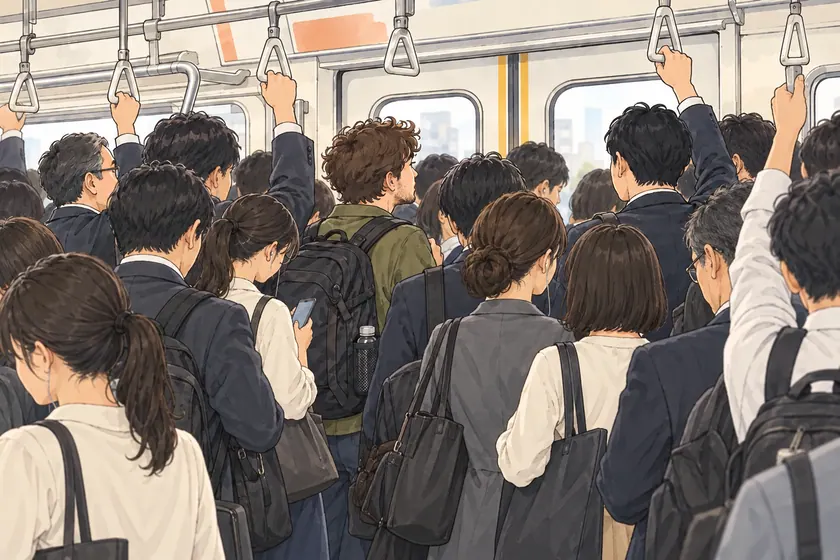
Keep suitcase wheels and bags out of doorways and aisles. Hold a bag so it does not swing into others, or use an overhead rack where suitable. Tokyo Metro's luggage and boarding guidance focuses on these shared-space basics. This is about ordinary commuter trains; special Shinkansen baggage rules are a separate topic.
Ask for help at the station
You do not need perfect Japanese to ask for help. Look for staff beside the ticket gates, a station office or an information counter. Some gates have a call button or intercom. Show the destination station on your phone, and if relevant show your ticket, card or route screen. Ask one concrete question: “Which platform?” or “Does this train stop there?” You do not need to explain the entire trip at once.
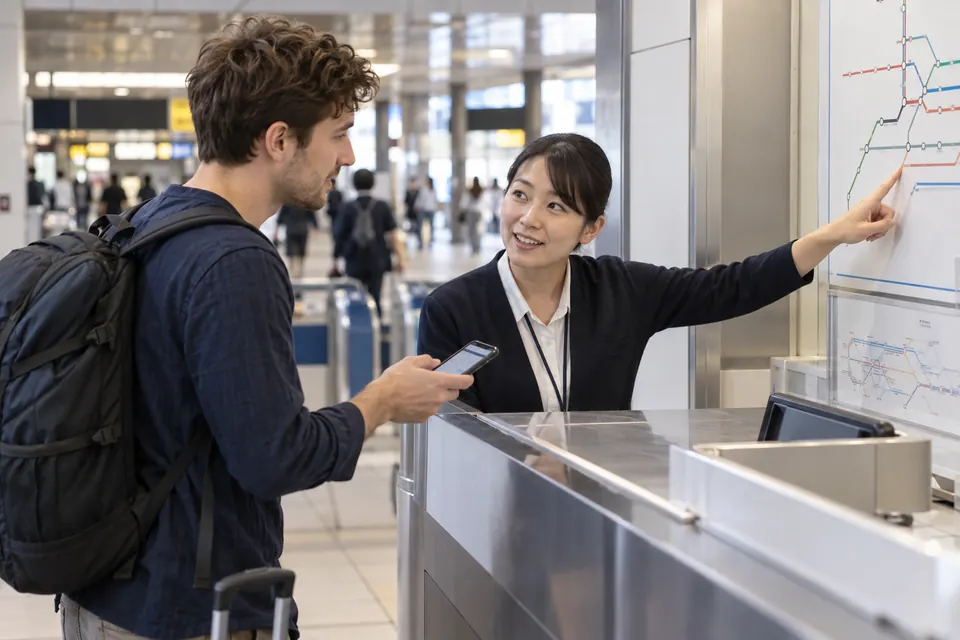
English help is available at some larger information centers, but not at every station or at every hour. JR East lists its information centers; the more reliable fallback is to show the written place name. If the first conversation is awkward, try a staffed gate with the route visible on your phone.
Useful Japanese you may see
These ten reviewed terms are worth recognizing on a sign or departure board. You do not need to pronounce them perfectly. The two existing phrase cards below can be shown to staff; enter your destination before displaying the platform phrase.
- 改札
- kaisatsu
Ticket gate - 乗換
- norikae
Transfer - ホーム
- hōmu
Platform - 各駅停車
- kakueki teisha
Local train - 快速
- kaisoku
Rapid - 急行
- kyūkō
Express - 特急
- tokkyū
Limited Express - 遅延
- chien
Delay - 運休
- unkyū
Service cancelled / not operating - 見合わせ
- miawase
Service temporarily suspended
These signs can help you recognize the next step. Always check the current display and staff directions.
{destination}に行きたいです。何番ホームに行けばいいですか?
Show this phrase to station staffこの電車に乗るには、乗車券やICカードのほかに、 特急券や指定席券が必要ですか?
Show this phrase to station staffQuestions first-time riders actually ask
Do I need Suica to ride a regular train?
No. A valid paper ticket is a normal option. An accepted IC card saves repeated ticket purchases, but it is not required for every ordinary trip.
Can I buy a paper ticket at the station?
Usually, yes. Tokyo Metro sells regular tickets at its station machines. Find the machine for the company you are using, check the destination and ticket type, and ask staff if the screen is unclear.
What if I cannot find my fare on the map?
Use the operator's route search or a destination-search feature on the machine where available. You can also show the destination to station staff before buying. Do not treat underpaying as the standard solution.
Does the gate give my paper ticket back?
A normal single-journey ticket should be returned at entry; take it and keep it. At the destination exit, the gate normally retains it. Passes and special tickets may behave differently.
What is the difference between Local and Rapid?
A local service generally makes more stops. A rapid service may skip some stations. The exact stops depend on the operator and route, so check the real train's stopping pattern.
Will the next train on my platform stop at my station?
Not necessarily. Compare the next train's type and destination with the displayed stop list. A platform can serve more than one kind of train.
Does a Limited Express need another ticket?
Often it does, but the product depends on the operator and train. Check the exact service and seat before boarding. The extra-ticket guide gives the short decision path.
Is an Express the same as a Limited Express?
No universal rule makes them the same. Railway companies use service names and ticket requirements differently. Check both stops and extra-fare rules for your train.
Do I leave the gates when I transfer?
Sometimes. A transfer can remain within the paid area or pass through a special or ordinary gate. Follow the signs for that interchange and ask staff before exiting if you have a paper ticket.
What if I board the wrong train?
Get off at a safe next stop, check your route and the service back toward your destination, and ask staff if the fare or gate handling is unclear. Do not assume the fare is automatically corrected.
What if I miss my stop?
Get off at the next stop, check the return train's stopping pattern, and ask staff about ticket or IC-card handling if necessary. Do not guess that the extra distance is free.
Can I bring a suitcase on an ordinary train?
Yes, if you can manage it safely without blocking doors, aisles or seats. Crowded commuter periods are harder with a large case; travel outside the busiest periods if your schedule allows.
Do trains run all night?
Do not count on it. Check the last usable departure, including each transfer, for your route and day. Live disruptions may change what actually runs.
Is substitute transport free when my train is suspended?
Do not assume so. The operator announces when an arrangement applies, which ticket holders qualify and which routes it covers. Ask staff before choosing a different operator or taxi.
Can I eat or talk on my phone on a commuter train?
Follow posted rules and keep the shared space comfortable. Tokyo Metro asks passengers to silence phones and avoid calls. Food can be impractical on crowded commuter services; long-distance trains differ.
Will station staff speak English?
Some staffed centers offer English support, but it is not guaranteed everywhere. Show the destination and route on your phone, then ask one short question at a time.
Sources & checks
Sources checked 24 Sept 2026. For changing details, confirm with the responsible organization.
- Tokyo Metro · Before getting on the subwayStation numbers and line colors; ticket-machine steps; gate entry; platform signs; boarding and onboard displays · Tokyo Metro examples, not a rule for every railway in Japan.
- Tokyo Metro · Getting off and transfersFare adjustment, ordinary paper-ticket collection, exit signs and operator-specific transfer gates · The orange-gate and timing instructions are Tokyo Metro-specific.
- Tokyo Metro · Regular ticketsPaper-ticket availability, fare calculation, underpayment adjustment and transfer exceptions · Current prices deliberately omitted from this general guide.
- JR East · Ticket overviewOrdinary local/rapid basic fare; separate limited-express and Shinkansen ticket layers; Green Car surcharge · JR East ticket examples do not define every other operator’s product.
- Tokyo Metro · Alternative transport during disruptionSubstitute transport depends on announcement, ticket eligibility and specified route; other costs are not universally covered · No general promise of free alternative transport.
- Tokyo Metro · Riding and luggage mannersLet passengers exit, keep doorways clear, manage backpacks/luggage and offer priority seats to those in need · Practical guidance for commuter-train behavior, not a nationwide legal rule.
- Tokyo Metro · Where to check delaysStation displays and operator channels for delays and suspensions · Display languages and reporting thresholds are operator-specific.
- JR East · Station timetablesStation-specific schedules and notice that live operations can differ from published times/platforms · Check the actual line, day and transfer before a late-night journey.
- Tokyo Metro · Station timetablesDirection-specific and weekday/holiday timetable lookup · Example timetable page; use the relevant departure station.
- Tokyo Metro · Passenger safety and off-peak travelDeparture time is when the train moves and doors close earlier; off-peak travel, crowding and luggage guidance · Japanese first-party guidance translated into English editorial advice; applies to Tokyo Metro, not every operator.
- Tokyo Metro · Things to consider when ridingPriority seating, quiet phones and avoiding running for trains · Operator-specific etiquette guidance.
- Tokyo Metro · Fares according to ageChild fare eligibility and conditional free travel for accompanied toddlers or infants · Tokyo Metro example; child-fare rules and special trains differ by operator.
Fares, timetables, stopping patterns and transfer rules can change. Confirm your actual train on the operator’s display or site before traveling.